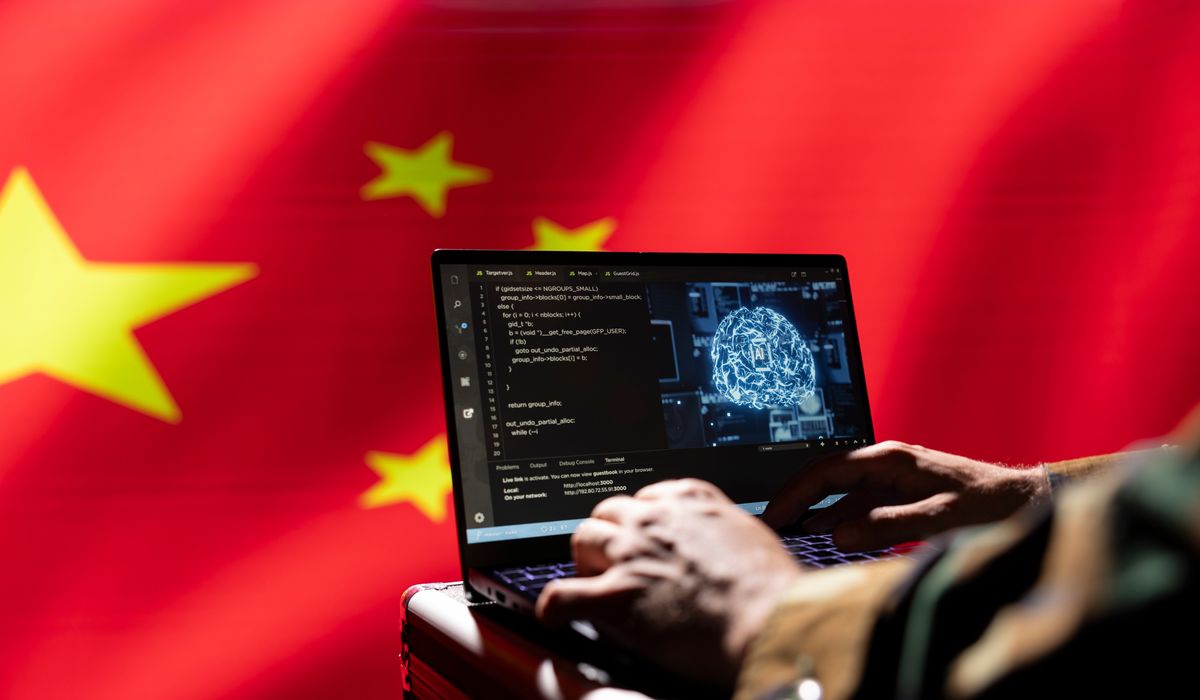
Advanced artificial intelligence systems now being used by China are a major threat to American national security, according to a think tank report.
Read more The Anti-Weaponization Fund: Trump’s $1.776 billion plan may be down — but is it out?
The report by the Center for New American Security said Beijing’s advanced artificial intelligence systems “pose a serious and growing threat to U.S. national security.”
At least seven Chinese developers now produce systems with powerful capabilities such as coding, reasoning, multimodal recognition, and agentic tasks downloadable by anyone in the world.
“The Chinese Communist Party (CCP), which collapses the boundaries between state, military, and private sector, treats these systems as instruments of political control, economic dominance, and great-power competition,” the report, made public Wednesday, states.
The most significant risks from Chinese AI are products of the communist system that builds, shapes, and deploys the systems.
“This party-state does not tolerate independent power centers and treats AI as a tool of statecraft across every dimension of strategic competition,” the report said.
Kinetically, China AI is enhancing military capabilities and offensive cyber operations. It is also fueling concerns about Beijing’s use of AI for biological weapons development.
Chinese cognitive warfare programs are being powered by AI through more effective censorship, surveillance and influence campaigns and effective espionage.
Economically, AI is driving China’s industrial dominance and creating dependencies that allow Beijing to extend its reach over both emerging and advanced economies.
“These risks affect the United States through two vectors: state instrumentalization, in which the CCP directly wields AI systems, and proliferation and dependency, in which Chinese systems spread globally through open-weight release, model compression, and aggressive pricing,” the report said.
Read more Georgia Republicans decline governor’s request to redistrict
The seven major AI developers were identified as Alibaba, Baidu, DeepSeek, MiniMax, Moonshot, Tencent, and Zhipu.
The most immediate danger is the use of AI in China’s aggressive offensive cyber operations.
“Ideological alignment with the CCP is deepening with every new model,” the report said. “DeepSeek-based agents are 12 times more likely to follow malicious instructions than their U.S. counterparts.”
The report urges the U.S. government to publish national security risk assessments of advanced Chinese AI systems and to issue more detailed cybersecurity alerts and advisories on the threats.
Adm. Sam Paparo, commander of the Pacific Command, said in April that the Chinese military is already using AI to boost combat power.
“I think they see AI’s power from a targeting standpoint, mass data analytics, to quickly discern where the target is, given the covariance among all the factors that come into various sensors,” Adm. Paparo told the Senate Armed Services Committee.
“I think they see the power of AI for strategic decision making, to know the game that you’re playing, to be able to suss out what an adversary’s intentions are, I think they’re right to see that,” he said.
The report, “Red Lines: Understanding the National Security Risks of China’s Advanced AI,” was written by CNAS senior fellow Daniel Remler.
Read more Trump’s shocking savior-of-Israel claim
About the Author