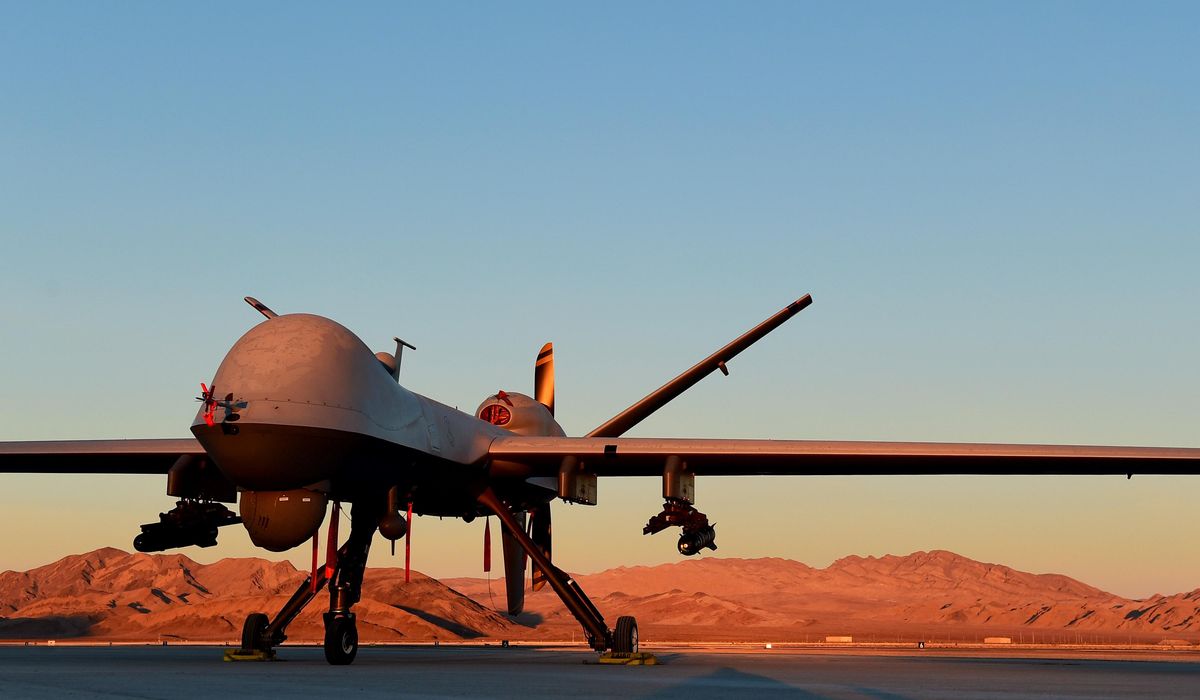
The U.S. Air Force has lost nearly 1/3 of the available fleet of critical Reaper drones in Middle East conflicts since the start of the Trump administration, including more than two dozen in the Iran war.
Read more Homeland Security’s Mullin says spy power lapse makes it more difficult to monitor threats
There is no active production line to build more, nor have the Pentagon and Congress produced a funded plan to replace them, according to congressional, military and defense industry officials.
The MQ-9 Reaper, made famous during the post-9/11 War on Terror, has played a central role in the U.S. military campaign against Iran. Gen. Kenneth Wilsbach, the Air Force chief of staff, called it a “tremendous capability.” But serious issues have surfaced as U.S. policymakers grapple with how to replace the Reapers.
The Reaper is just one part of broader losses the Air Force has sustained in the Iran war, which began Feb. 28. The Congressional Research Service said in a recent report that at least 42 aircraft — 28 MQ-9 Reaper drones, four F-15E Strike Eagle fighter jets, one F-35 and seven KC-135 refueling tankers — are among those lost. Another 17 drones have been shot down during clashes between the U.S. and Yemen’s Houthi rebels, an Iran-backed terror group, over the past nine years.
A combination of new “loitering” munitions, Iranian anti-aircraft missiles and even Iran’s recent attacks on U.S. bases in the region have whittled away at the Air Force’s Reaper fleet.
While the total number is technically classified, sources confirmed to The Washington Times that at least 45 MQ-9A Reaper drones have been lost in the Middle East since 2017.
That’s left the Reaper platform at a crossroads amid a slow-motion push inside the Pentagon and on Capitol Hill to come up with ways to replace the assets lost in the Mideast.
At a classified briefing this week, Adm. Brad Cooper, the head of U.S. Central Command, told senators that he needs the lost Reaper drones replaced, according to two sources familiar with the briefing.
It’s unclear how that would happen.
Understanding the Reaper
General Atomics — the drone’s original manufacturer — shuttered production of the MQ-9A Reaper aircraft in 2025 after orders from the Air Force dwindled. Now, after nearly $1 billion in lost MQ-9As, the company is offering its MQ-9B SkyGuardian instead.
But that would require a new line of funding from Congress.
“The MQ-9A Reaper line was closed in 2025, and that was not a General Atomics decision. We argued against that and lost,” C. Mark Brinkley, the senior director of strategic communications at General Atomics, wrote in a social media post. “You can take some offline Reapers and put them online again. That will get you some number of aircraft, but it’s not a long-term fix.”
The MQ-9A owes much of its reputation and prolific use to its capabilities. The Reaper is one of the most prominent uncrewed systems used by any U.S. military branch. It was originally designed as a lethal-capable surveillance and reconnaissance aircraft. It eventually found a place in the global War on Terror as a “hunter-killer” platform, carrying Hellfire and Paveway missiles as well as larger GPS-guided bombs.
The $15-to $30-million dollar drone can carry up to six attachments on its 66-foot wingspan and fly more than 24 hours at high altitude. The Reaper’s sensor array includes many capabilities found on much larger manned aircraft, such as infrared sensors, color daytime and night-vision cameras with high-power zoom and radar.
The Air Force has tried for years to find a successor to the drone, dubbing recent efforts the “MQ-9 Next” program. But those aircraft won’t immediately solve the current capabilities gap.
There are some Reaper parts and company-owned aircraft available, but they account for fewer than 10 full units, according to General Atomics. The Air Force publicly said it will “cannibalize” available Reapers to provide as many as possible to U.S. Central Command. They also may have other options.
“What we’re taking now is to refurbish and ready the remaining [Reapers] that we have,” Gen. Wilsbach told members of Congress on June 9. “We still have a lot of them, I don’t want to say a number because it’s classified, but we still have a lot of them.”
“We’re not in a crisis with the MQ-9 at the moment,” Gen. Wilsbach said.
But Air Force Lt. Gen. David Tabor, the service’s deputy chief of staff for plans and programs, told lawmakers in May that the Air Force is in such dire need of the platform that it is trying to “buy back as many of the MQ-9As as we possibly can right now.”
Lt. Gen. Tabor told Congress in May that only 135 Reaper aircraft are available in the Air Force inventory. The losses in Iran and Yemen have destroyed up to one-third of the total fleet.
To replace them, General Atomics is encouraging the purchase of the MQ-9B SkyGuardian.
“You can buy MQ-9Bs, either full-up aircraft or modified, slimmed-down versions. That is a long-term fix,” Mr. Brinkley wrote. “Other nations agree and are buying them now. That line is hot and running. The price will ultimately depend on what you ask for, but a full-up MQ-9B to the U.S. is about $30 million, less if we slim it down.”
The MQ-9B production line is currently building aircraft for many NATO partners. About 100 are being produced now for ten different countries. That includes the United Kingdom, Canada, Belgium, Denmark, Germany and Poland — all NATO members that have drastically increased their military spending in recent years.
The amount of requests has, according to General Atomics, made that production line comfortably stable for the next few years. Those are all foreign military sales, meaning that at any time the U.S. Air Force could jump the line and request the next available aircraft that met its requirements.
Read more WATCH: Grassley on Arctic Frost, judicial activism and the fight to protect constitutional rights
“We are offering the U.S. Air Force modular options for MQ-9B, at a price that reflects the DOW’s requirements and can be delivered today, not someday,” Mr. Brinkley wrote.
Should lost Reapers be replaced?
But production capability may not be enough. Some analysts question whether replacing the Reaper is even the right call.
“The MQ-9 proved to be completely non-survivable in the Middle East. This should raise questions about the utility of the platform in conflict, especially major power wars,” Jennifer Kavanagh, the director of military analysis at Defense Priorities, told The Times. “It is probably worth buying back aircraft that have been sold to police departments or other organizations but I am skeptical about putting a ton of funding into replenishing what was lost in Iran.”
Defense Priorities is a Washington-based think tank that advocates for a more restrained U.S. military role abroad.
Ms. Kavanagh sees other platforms and cheaper alternatives as more of a winning — and affordable — combination. She pointed to space assets and “really cheap reconnaissance drones that you expect to lose” as a better investment.
But those won’t come online fast enough for the current conflict.
“The U.S. is very slow and way behind other countries in cheap UAV production and despite lots of hype and money, progress is at a glacial pace,” Ms. Kavanagh said.
Congress is actively negotiating the Trump administration’s $1.5 trillion defense budget at the same time Adm. Cooper is pushing for more Reapers. Much of that requested money was originally earmarked for new defense technology and investments in future platforms, but some of it is now being redirected for the U.S. operation against Iran.
“Part of the mind-bending problem that’s actually happened in the Iran conflict is that it has reinforced that the tech we have purchased is really good and works really well,” Rep. Pat Harrigan, North Carolina Republican, told The Times.
Rep. Harrigan is a consistent voice asking for investment in new drone technology and, as a former U.S. Army Special Forces officer, he has assumed a growing role in the modernization effort on the House Armed Services Committee.
But now he’s worried there won’t be enough funding to go around.
“The right balance is both. What level is that? It depends on who you talk to in Congress,” he said of investing in new technology but also needing to replace platforms lost in the Middle East. “I don’t know that there’s going to be an infinite amount of money to do both.”
Sen. John Hoeven, North Dakota Republican, was asked about the MQ-9 losses during last week’s hearing with Air Force leadership. He said the U.S. was “losing a lot of MQ-9s over there,” and even though “the MQ-9A line is not operating, the B line is up, so that’s an option too.”
A large portion of the funding for the new military budget is coming from a supplemental budget request to Congress, one that includes the funds needed to replace the Reaper. It could require a larger budget to purchase newer MQ-9B SkyGuardians instead of MQ-9A Reapers, a problem Congress is well aware of.
“They’re making the B, but a lot of the stuff that we’re used to using goes on the A line, not the B,” Mr. Hoeven told The Times. “They’re on it, because that’s defense. But I am concerned about funding.”
The risk is that it’s not just Reaper replacement costs. The war has put pressure on the administration’s supplemental funding request in numerous ways, adding unanticipated expenses.
“This is a challenge we’re seeing right now,” Sen. Lisa Murkowski, Alaska Republican, told The Times.
Ms. Murkowski believes the problem extends beyond the Mideast. She worries that some key programs are too low for the U.S. to maintain its levels of support for Ukraine, which remains locked in a bitter war with Russia.
“The rapid depletion of our munitions and the different programs … this is what we’ve got to be asking some pretty serious questions about,” she said.
Despite any efforts Congress may make on funding programs to replace critical systems, including the lost Reapers, the Iran war is still dragging on. The slow and deliberative process of Congress, in particular a Congress that has yet to officially declare war, is starting to show signs of not being able to keep pace with reality. It isn’t a fact lost on the lawmakers working through the problem.
“You know how it is around here, everything kind of gets delayed,” Mr. Hoeven said. “But these guys are operating in real time.”
Read more From rockets to brain implants, here’s a look at Elon Musk’s vast empire
About the Author