OPINION:
Shortly after 9 p.m. on July Fourth, a fireworks extravaganza hailed as “a landmark moment in fireworks history” will light up the skies above the National Mall in Washington.
Read more Iran: Lebanon’s sovereignty is a necessary part of the peace deal
Unfortunately, if polling data is any indication, many of those marveling at the pyrotechnic spectacle will care little about the actual occasion we are celebrating: the 250th anniversary of American independence.
In fact, many of our younger citizens, in particular, see our country and U.S. society generally as nothing special — or worse.
If only they knew better. If only their schools taught them better.
It is not just the signing of the Declaration of Independence that we celebrate on the Fourth of July. It is what the Declaration stands for and states: “that all Men are created equal, that they are endowed by their Creator with certain unalienable Rights, that among these are Life, Liberty, and the Pursuit of Happiness.”
All this and more are spelled out in just 1,320 words that stand as the foundation of the American experiment.
The Preamble to the Constitution adds additional detail: “We the People of the United States, in Order to form a more perfect Union, establish Justice, insure domestic Tranquility, provide for the common defence, promote the general Welfare, and secure the Blessings of Liberty to ourselves and our Posterity, do ordain and establish this Constitution for the United States of America.”
Harvard Business School’s best and brightest graduates would be hard-pressed to write a more perfect mission statement.
All of us must be sober and clear about America’s rough-and-tumble history. It has not always been pretty.
It is also important to remember that, for virtually everyone on earth, life was, in the words of Thomas Hobbes, “nasty, brutish, and short” until the mid- to late 1800s, when the “modern science of hygiene” was developed.
We also need to remember that chattel slavery — where one person can buy, sell and “own” another — was far from a uniquely American institution. Slavery was common throughout the world until the 1800s, and was still legal in the West African nation of Mauritania as recently as 1981.
In fact, forced labor, including human trafficking, remains a serious problem in many parts of the world, with countries in “Asia and the Pacific” having the highest number of people victimized by the practice, and “the Arab States” the highest percentage, according to the United Nations.
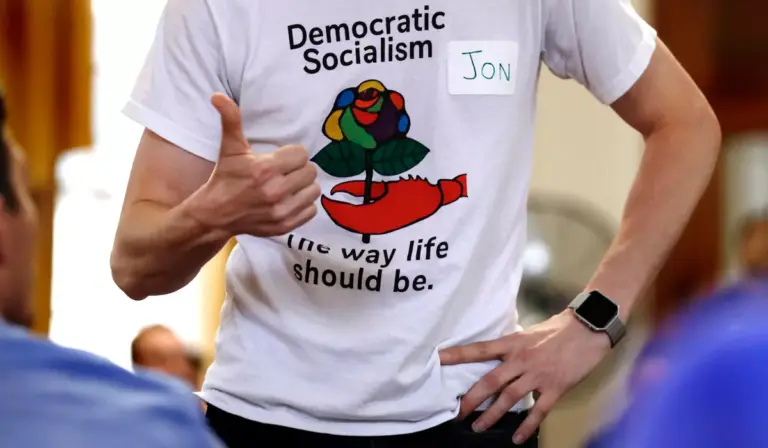
So why are so many young Americans down on their country? Why did a 2025 national survey show that nearly two-thirds of U.S. adults younger than 30 have a “favorable” view of socialism and one-third have a favorable view of communism?
Read more Trump, Macron make nice at the G7 summit in France
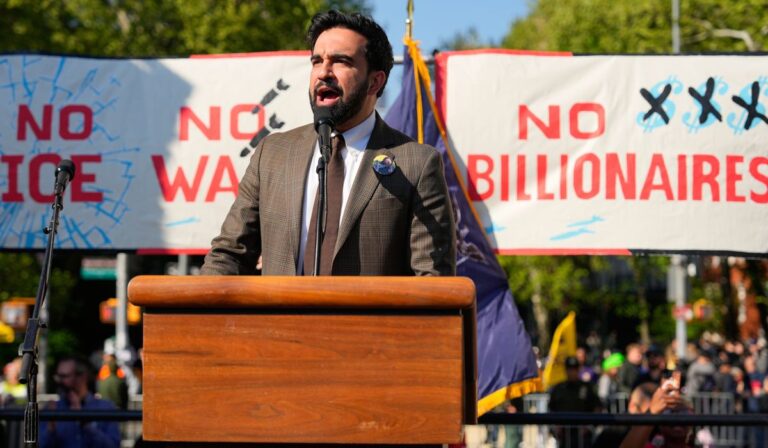
Perhaps it is because that is what some students have been hearing from their teachers — that, to quote from National Education Association “May Day” materials, Americans “are under attack from billionaires who have bought off our politicians and rigged the system to crush working-class families.”
These “billionaires,” the NEA says, are “trying to corrupt our democracy, target our families, and destroy our dignity.”
With inflammatory language such as this, it is no wonder that many young people are ready to man the barricades.
Yet it is not just the young. A series of recent surveys by North Dakota State University’s Challey Institute for Global Innovation and Growth reveals, in the words of NDSU professor John Bitzan, “a startling disconnect in student understanding of socialism and capitalism.”
The surveys also show that most U.S. college students do not realize how much life in the United States and the world has improved in the past half-century on key indicators such as “life expectancy, literacy, poverty, access to food, and access of education.”
Indeed, the most recent survey shows that more U.S. college students think life has “gotten worse” during this period (46%) than think it has improved (43%).
Instead of requiring remedial education in civics, history and economics in college, we need to demand that our secondary schools do their jobs so we can make higher education, well, “higher” again.
If our brightest do not realize how much better off we are than earlier generations, they could not possibly understand why: America’s free market economic system.
Even in countries such as China, where the percentage of people living in extreme poverty plummeted from an estimated 88% or more in the mid-1970s to near zero today, the remarkable progress is the result of free market reforms, launched in 1978 under Deng Xiaoping.
The sad truth is that many Americans, especially younger ones, do not understand their country. As a result, they neither appreciate nor love it, putting them at risk of losing it.
America’s teachers have a responsibility to right this wrong.
• Richard N. Lorenc, a former executive vice president of the Foundation for Economic Education, is the president and CEO of Lexandria, an education nonprofit that seeks to reignite the American spirit through innovative classroom content and tools.
Read more Trump predicts ‘great things’ for Middle East, markets after memo signing with Iran
About the Author