Snoozing through the semiquincentennial is no longer an option, thanks to President Trump.
Read more 1 killed when small airplane crashes on Texas highway. People leave vehicles to try to help
Americans wondering when the nation’s 250th birthday party would get rolling were answered last weekend as the White House hosted the UFC Freedom 250 cage fight — an over-the-top patriotic spectacle that was either “tragically tacky” or “absolutely brilliant,” depending on your political affiliation.
What’s undeniable is that the show brought badly needed attention to the 250th anniversary of the Declaration of Independence, a national milestone at risk of being commemorated with a whimper instead of a bang.
The headlines tell the story.
“Where’s the Hype for America250?” asked Scott Greer, author and host of the Highly Respected podcast, in a May 23 article in The American Conservative.
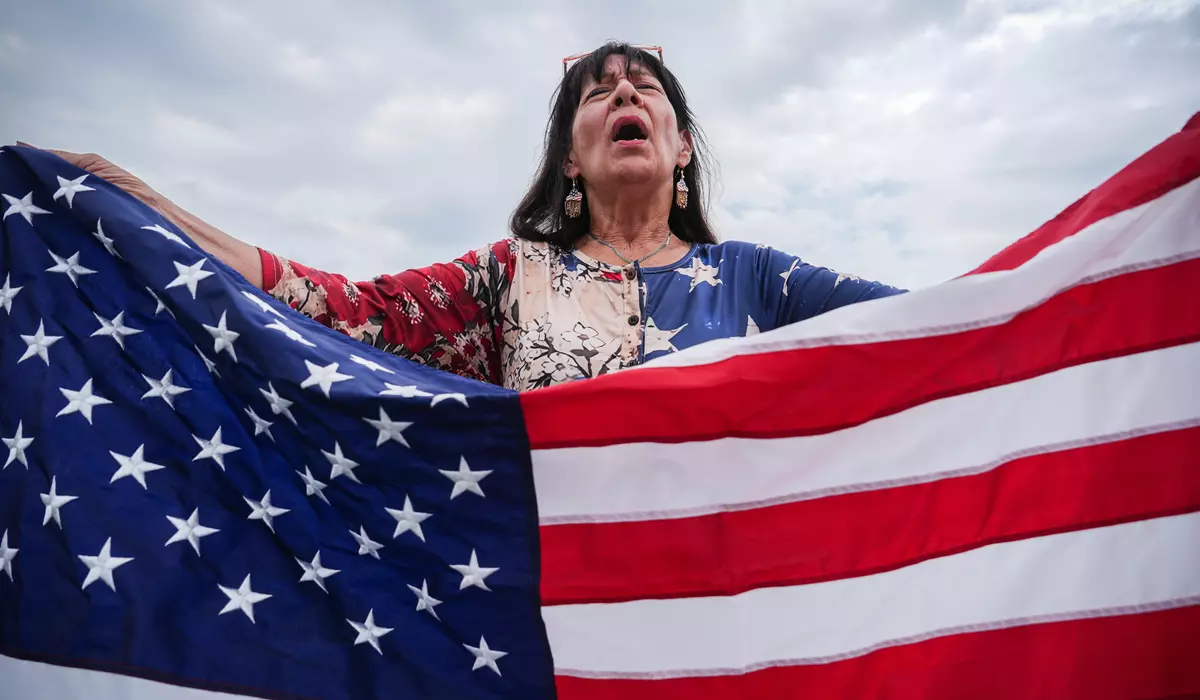
“On the country’s 250th anniversary, the American people are in a sour mood,” said the Pew Research Center in a June 12 analysis.
Mike Carpenter, a principal of Carpenter Civic Strategies, noted in a June 12 op-ed that “the celebratory tone and patriotic sentiment are missing for many Americans.”
Analysts blamed the lack of enthusiasm on a host of factors, including increased political polarization, declining patriotism and an increasing tendency for individuals to identify more closely with their partisan allies than their fellow countrymen.
“Our views about the country, not just the direction we are headed but the nation itself, are tied to partisanship in a way they weren’t in the past,” Travis Taylor, Strategic Insights research president and chief research officer, told The Washington Times.
“Patriotism used to transcend politics. Being an American used to be more important than being a Democrat or Republican. Now, how we feel about the nation itself is tied to the party that controls government,” he said. “If we’re part of the in-party, we feel pretty good about America, and when we belong to the out-party, we turn sour.”
Patriotism is also on the wane. Only 33% of adults surveyed describe themselves as “very patriotic,” according to an NBC News poll released Sunday, a record low for a poll question being asked since 2000.
Meanwhile, 11% of respondents said they were “not patriotic at all,” representing an all-time high.
“People just don’t care about America the same way the older generations did,” Mr. Taylor said. “Although the ship seems to be turning back toward a knowledgeable citizenry, it may not happen quickly enough for the 250th to land with the same splash the bicentennial did a generation or two ago.”
Indeed, the semiquincentennial is undoubtedly suffering by comparison with the U.S. Bicentennial celebration, a 1975-76 series of events that riveted the nation’s attention.
Walter Meyer, an author and host of the Walt’s Wanderings channel on YouTube, recalled the Bicentennial Minutes segments that CBS-TV aired nightly from 1974-76; the U.S. Postal Service’s commemorative stamps, and the patriotic packaging on products.
“I still have some of the commemorative glasses and coffee mugs that were made by soft drink and other companies,” Mr. Meyer said. “The vibe is very different for what could have been another fun and historic celebration. Even prior to Donald Trump reentering the White House, none of the hype started that we had leading up to the Bicentennial. No minutes in primetime, no souvenir glasses or coffee mugs. I think a lot has changed in the last 50 years.”
That includes the media landscape. Even if CBS or another network had decided to air Semiquincentennial Minutes, for example, the impact wouldn’t be the same, said Katherine Machado-O’Hara, founder and president of the Oxigeno Project, a marketing firm.
“What I can’t help but wonder is if what we’re seeing isn’t a lack of enthusiasm in the 250th but more a lack of a singular narrative,” she said. “In 1976, Americans largely experienced the Bicentennial together. In 2026, Americans are experiencing the nation’s 250th anniversary through thousands of different media channels, communities and perspectives.”
Another problem: the name. “Semiquincentennial” doesn’t roll off the tongue the way that “bicentennial” does.
“The semiquincentennial – that’s a mouthful,” said David Bobb, president of the Bill of Rights Institute. “Let’s call it A250 for short. In the Latin, it means you’re halfway to 500.”
Read more Starmer’s Waterloo? : Andy Burnham emerges as Labor’s answer to Reform Party surge
Two committees, one celebration
The official semiquincentennial celebration is headed by America250, the nonpartisan nonprofit organization created by the U.S. Semiquincentennial Commission, which was established by Congress in 2016.
Led by former U.S. Treasurer Rosie Rios, America250 has taken a grassroots approach, seeking to “engage all 350 million Americans (350 for 250)” by encouraging local gatherings, community service, and charitable giving.
The organization’s local focus may have jibed well with another president, but not Mr. Trump, who was born for the big stage.
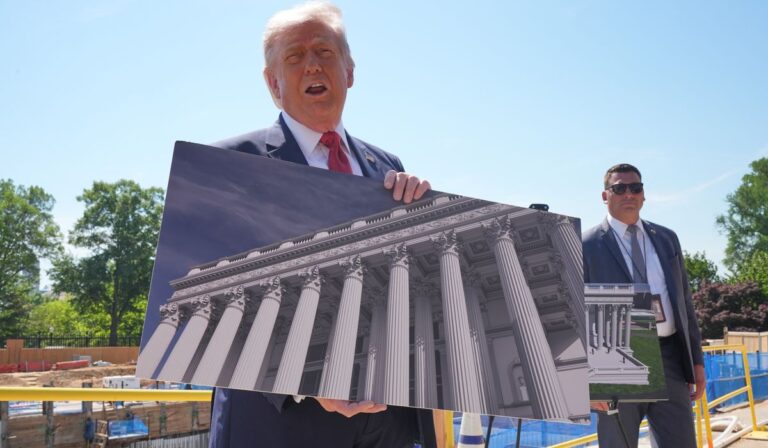
Last year, he launched Freedom 250, a public-private partnership focused on hosting splashy, high-octane events at prominent national venues such as the White House and the National Mall.
Certainly there was nothing understated about UFC Freedom 250, which showcased mixed martial arts fighters, motorcycle jumpers, thousands of military personnel, a “Super Delta” flyover, a bald eagle flyover, and massive fireworks, as well as the requisite anti-Trump protesters and foiled terrorist attack.
Next up is the Great American State Fair, which runs June 25-July 10 on the National Mall. The Freedom 250 event includes a livestock showcase and Rodeo 250, a “journey through the evolution of the American cowboy” featuring multiple roping and riding shows.
The Freedom 250 fest culminates in a July 4 spectacular headlined by Mr. Trump on the National Mall that boasts military flyovers, “the largest ceremonial military ensemble ever assembled,” and “the largest fireworks display in history.”
Freedom 250 has been accused of upstaging America250, but Ms. Rios said their work is complementary, not competitive.
“As the national organization charged by Congress to represent all 350 million Americans (‘350 for 250’), America250 will continue to focus on the values-based programming approved by our bipartisan Commission at the local, state, national and international levels, including once-in-a-lifetime celebratory moments during the 4th of July weekend,” she told The Times.
“We are supportive of the many other organizations planning events for the 250th at the federal, state and local level, so all Americans have ample opportunities to join in the celebration,” she said.
Less supportive are Democratic governors. At least seven have announced that they will not sponsor displays at the Great American State Fair, citing concerns about cost and scheduling conflicts.
States opting out so far include Connecticut, Illinois, Maine, Massachusetts, North Carolina, Oregon and Washington.
Luke Harkins, spokesperson for Oregon Gov. Tina Kotek, also cited “growing concerns that the event in Washington, D.C., is shaping up to be a more partisan affair than originally presented.”
“The Governor will still be proudly celebrating America’s semiquincentennial here in Oregon, and is looking forward to all of the great exhibitions and events the America 250 Oregon Commission will be planning through the summer and beyond,” he said in a statement.
The build-up to America’s 250th birthday may be taking longer, but Ms. Machado-O’Hara predicted that Americans will put their differences aside and join the festivities come July 4.
“My suspicion is that enthusiasm hasn’t peaked and we will continue to feel a build as the date approaches,” she said. “The question is whether, in today’s fragmented media and political environment, it’s still possible to make 330 million people feel like they’re participating in the same moment and the same message at the same time.”
Mr. Bobb, co-author of the newly released book “Divided Over the Declaration: How an Enduring Debate Sustains the Vision of America,” said he hopes that the sense of unity will last.
“To be an American is to rely on principles, among which is the dignity of every human being, right? All men are created equal,” he said. “And it’s also recognizing we’re going to have a big debate about these principles, and we’re going to try to figure it out together. That’s what I would like to see as the legacy of A250.”
Read more Rare-earth minerals race: Pentagon to invest $500 million in American rare-earth processing company
About the Author