SEOUL, South Korea — As China rallies friendly nations against Japan, Tokyo is fortifying relationships across the democratic world in defiance of Beijing.
Read more Trump tells gas companies to drop prices fast or face price-gouging probe
Japan is tightening defense ties across the region, notably with Australia and the Philippines, while positioning itself as an arms partner in Asia and Europe. It is signaling military determination, from fortifying strategic islands to joining an airborne drill on a Philippine island near Taiwan.
While a narrative battle rages between Beijing and Tokyo, the regional wild card is South Korea. Seoul remains wary of Tokyo, its former colonizer, and recently signaled resistance to closer defense engagement.
China marshals its allies
In an apparent united front, Chinese and North Korean state media have used the same term to describe Japan — “neo-militarization” — since January, according to Japan’s Kyodo News.
During his June 8-9 summit in Pyongyang with Chinese President Xi Jinping, North Korean leader Kim Jong-un voiced support for Beijing’s “One China” policy — its territorial claim to democratic Taiwan.
While millennial Japan is firmly entrenched in the democratic world, Mr. Kim referenced Japan’s World War II aggression.
“Japan, a defeated country in Asia, has openly turned itself into a war state by taking the present disturbing circumstances as an opportunity to get rid of all shackles restricting its moves to become a military power,” the North Korean leader told a ruling party meeting, the state-run Korean Central News Agency reported Tuesday.
Kyodo News noted that other China-friendly nations — Myanmar, Mongolia, Pakistan and Russia — are using similar terminology.
Beijing may be marshaling allies in its multi-domain campaign against Japan.
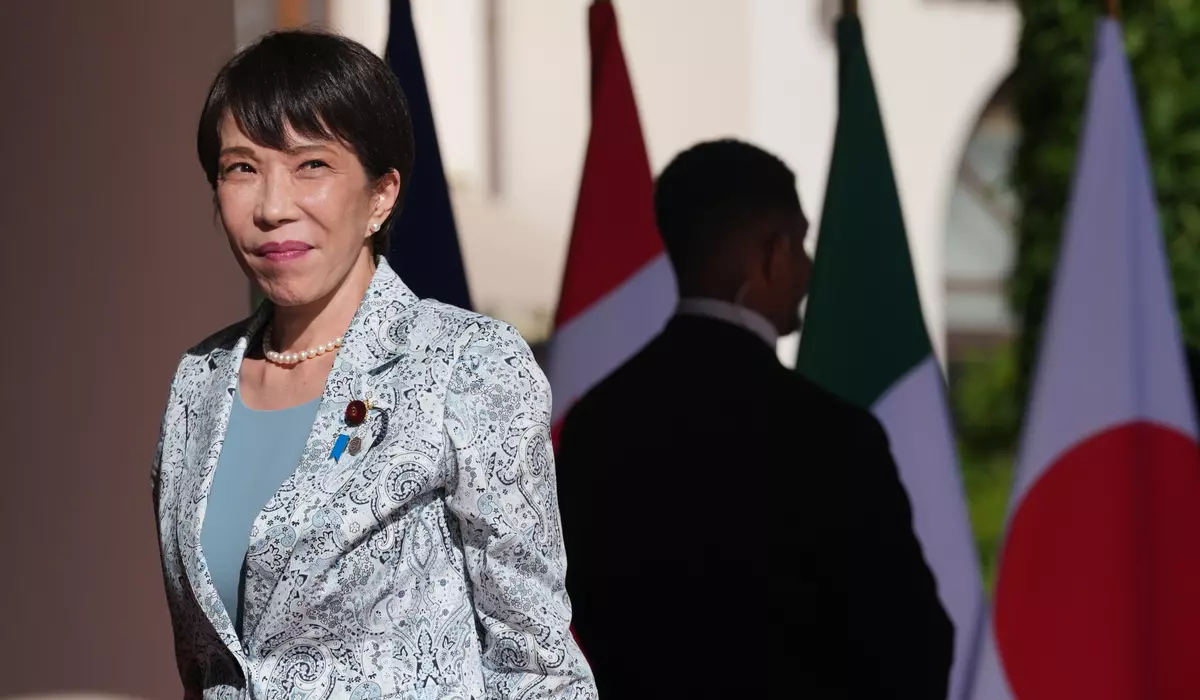
Japanese Prime Minister Sanae Takaichi said in November that a Taiwan contingency would confront Japan with an existential situation. Constitutionally, that enables the activation of Japan’s Self-Defense Force.
That is problematic for Beijing.
Japan has been quietly rearming since a constitutional reinterpretation in 2015. It cannot compete with China’s navy (Beijing’s fleet outnumbers the U.S. Navy by hull count), but Japan’s Maritime Self-Defense Force is powerful.
It fields more escorts than Britain and France combined, stealthy diesel-electric submarines, two light F-35 aircraft carriers and an amphibious brigade. Japan is also acquiring 400 Tomahawk long-range cruise missiles.
Critically, Japan is fortifying the southwestern Ryukyu Island chain, which dominates key straits east of Taiwan. Sensors, electronic warfare systems, missiles and a proposed drone force, SHIELD, are being emplaced across the islands.
Beijing responded to Ms. Takaichi with diplomatic catcalls, cuts to Chinese tourism, seafood import bans and academic enquiries into Japan’s rule over the Ryukyus.
Ms. Takaichi refused to withdraw her remarks and deployed Defense Minister Sanjiro Koizumi to the Ryukyus. She also gave him free rein to speak out.
China “is a country that possesses a huge arsenal of nuclear weapons and strategic bombers,” Mr. Koizumi told last month’s Shangri-La dialog, the leading regional defense forum, in Singapore. “Japan possesses neither … yet it is labelled as ‘new militarism.’ Isn’t that strange?”
Japan fortifies friendships
Japan’s core security relationship is with Washington, with whom it has a mutual defense treaty, but it is expanding partnerships across the Global North.
Before the June 15-17 Group of Seven summit in France, Ms. Takaichi stopped in London and Rome, where she won commitments from the respective leaders to accelerate the Global Combat Air Program.
A trilateral agreement to build the GCAP, a sixth-generation stealth fighter, was signed in 2023, but there had been concerns about funding and timelines.
Japan and the United Kingdom signed a Reciprocal Access Agreement in 2023, permitting the seamless transfer of troops, kit and weaponry between the two nations. The RAA was based on an agreement Japan signed with Australia in 2022.
Visiting Canberra in May, Ms. Takaichi made an unusual gesture: She knelt before the Tomb of the Unknown Soldier.
That was welcomed by her hosts, who had fought a brutal war against Japan in the Pacific in the 1940s, but it infuriated China.
“A political calculation aimed at pleasing West, but offensive to Asian neighbors,” the state-run newspaper Global Times said in a headline.
In April, Japan’s Mitsubishi won a bid against German rival ThyssenKrupp to build and sell 11 Mogami-class stealth frigates to Australia for $6.5 billion — Japan’s first major overseas arms deal.
After easing decades-long controls on military exports in the same month, Tokyo is now offering Mogamis to New Zealand and used vessels to Indonesia and the Philippines.
In May, Japan signed a defense agreement with Indonesia, albeit largely based on equipment supply. Japan’s defense engagement with the Philippines is more strategic.
Read more U.N. nuclear chief says inspectors will visit Iran sites. Tehran says only after a final deal
Manila is fighting a rearguard action against Beijing’s maritime encroachments in the South China Sea, while its northern Islands dominate a key western approach to Taiwan.
Not only is Japan offering Manila kit, it signed an RAA in 2024, and this year, it sent combat troops to join multinational drills.
In May, Ms. Takaichi hosted Philippine President Ferdinand Marcos Jr. in Tokyo, where they agreed to expand intelligence and military ties. Manila is interested in Japanese destroyers, aircraft and surface-ship missiles.
Japanese paratroops will reportedly join a free-fall practice drop on Batanes, the Philippine islands closest to Taiwan, this month. The chain covers the Bashi Channel, a southwestern approach to Taiwan.
All this suggests Japan is winning the narrative war.
“The region is buying what Japan is selling more than what Beijing is saying,” London think tank the Royal United Services Institute wrote in a May analysis.
Why is Tokyo reaching out?
The expansion of China’s regionally based military vis-a-vis globally stretched U.S. forces is forcing Japan’s step up.
“China’s military build-up has tilted the regional military balance against Japan’s security guarantor,” said RUSI, referencing the U.S.
At issue is not simply Washington’s capability to project power — but its willingness.
At a time when figures in Washington are trolling and lambasting allies, and when a $14 billion arms sale to Taiwan remains frozen, Tokyo has voiced concerns.
At the Shangri-La dialog, Mr. Koizumi suggested to U.S. Secretary of War Pete Hegseth that “some countries might underestimate” U.S. commitment.
Many Asian nations, “like Japan and South Korea, no longer feel confident that the U.S. will defend them if attacked,” opined the U.S. Council on Foreign Relations in June.
While Japan has not copped the heavy American flak that NATO capitals have, it currently spends under 2% of GDP on defense. Washington demands 3.5%.
Moreover, Tokyo has, like NATO capitals, declined to join the U.S. against Iran, despite its competency in mine-sweeping.
“Unlike the U.S., nobody in Japan subscribes to the idea that Iran is a suicidally inclined regime that would use nuclear weapons,” said Paul Midford, an American political scientist based at Japan’s Meiji Gakuin University.
Along with shared concerns over U.S. will, Japan’s swelling defense muscle offers it a rising voice.
“Engagement with NATO is recognition that Japan has arrived as a legitimate, semi-global power that can assemble and project force,” said Lance Gatling, principal of Tokyo-based Nexial Research and a former planning officer with U.S. Forces Japan.
Mr. Gatling reckons that NATO players would not likely fight for Taiwan but could play a role west of a critical regional trade channel, the Strait of Malacca, given China’s likely recognition of the massive import of maritime chokepoints in the Iran conflict.
“Would the British or French show up with a frigate in the region?” he asked. “That would complicate the game in favor of their partners in Asia, as they can raise the cost of [Chinese] operations in the Indian Ocean.”
Still, one democratic partner remains uncharmed by Tokyo: Seoul.
Ms. Takaichi has enjoyed amicable relations with South Korean President Lee Jae-myung, but Mr. Lee said during a June 6 press conference that a proposed logistical sharing agreement between both nations’ militaries is conditional upon another Japanese apology for its often-brutal colonization of the peninsula from 1910 to 1945.
“There must be a sincere apology,” Mr. Lee said.
Japanese emperors, prime ministers and Cabinet secretaries have offered over 70 apologies, and Tokyo has granted two tranches of reparations. However, many Koreans question Japanese sincerity.
“Takaichi is not likely in a position to give any type of apology to Korea, given her nationalistic base,” said David Park, a Korean-American GWOT veteran with close ties to Japan.
Upcoming: Whether she will visit Tokyo’s controversial Yasukuni Shrine — where a handful of war criminals are enshrined among Japan’s millions of war dead — on the anniversary of World War II.
“I am sure there will be more drama once Aug. 15 comes,” said Haruko Satoh, a regional affairs specialist at the University of Osaka.
Mindful of regional sentiments, no Tokyo prime minister has visited Yasukuni since 2013, but some Japanese have urged Ms. Takaichi to do so — particularly after her Canberra kneefall.
Read more Trump tells congressman he’s endorsed ‘no one wants to hear from you’
If she does, Beijing, Pyongyang and Seoul will likely be united in opposition.
About the Author