KYIV, Ukraine — Kyiv says Russian drone attacks facilitated by equipment in neighboring Belarus have gone quiet after Ukrainian President Volodymyr Zelenskyy last week warned his Belarusian counterpart the Ukrainians were weighing retaliatory strikes.
Read more Shipbuilding hurdles impede Navy’s ability to keep pace with well-equipped adversaries, experts warn
The episode marks one of Ukraine’s sharpest warnings to Belarus President Alexander Lukashenko since the opening stage of Russia’s full-scale invasion, when Moscow used Belarusian territory as a launchpad for its failed assault on Kyiv.
Mr. Zelenskyy said Ukraine had identified four signal relay stations in the Belarusian regions of Gomel and Brest, near the Ukrainian border. According to the Ukrainian president, the equipment has helped Russian drones strike targets in the Zhytomyr, Rivne and Volyn regions, including energy facilities, rail infrastructure, cities and villages.
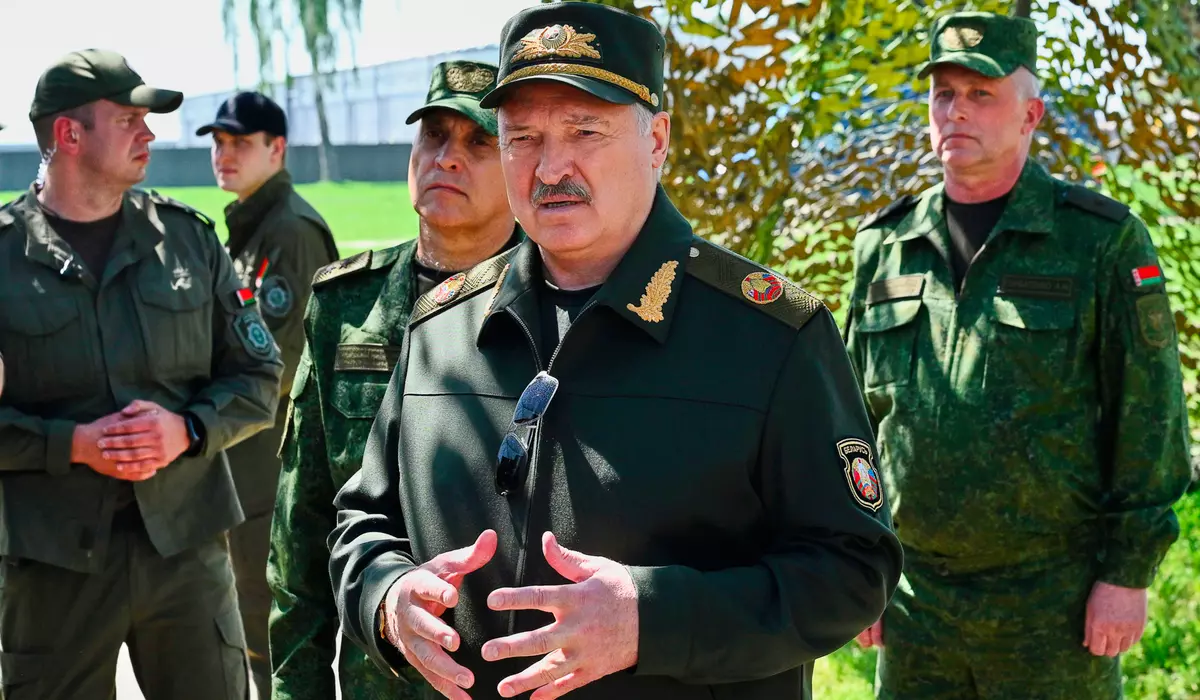
“If he doesn’t do it, we’ll do it,” Mr. Zelenskyy said, referring to Mr. Lukashenko during a press conference on June 19. In a later address, he said Belarus still had time to dismantle the equipment and prove that it did not want to be pulled deeper into the war.
By Wednesday, Mr. Zelenskyy said Ukrainian intelligence and Commander in Chief Oleksandr Syrskyi had reported that the relay stations stopped operating two days earlier. Kyiv has not said whether the systems were physically dismantled, switched off temporarily or disabled by other means.
The claim has not been independently verified, and the immediate military effect remains unclear. Ukrainian border officials have reported a reduction in Russian Shahed drone activity from the Belarusian direction in recent days, but Ukrainian military sources have cautioned that pauses in such activity have happened before.
Still, the political signal is unmistakable: Kyiv is telling Minsk that Belarusian infrastructure used by Russia can no longer be treated as untouchable.
James Rushton, an independent security and foreign policy analyst, said Mr. Zelenskyy’s warning should be read as a real threat to Minsk, not merely as a message aimed at Moscow.
“I think it’s a genuine warning,” Mr. Rushton told The Washington Times. “Historically, as much as Russia and the Kremlin have wanted Belarus to get directly involved in the war, they haven’t. Lukashenko has resisted this because he knows that getting directly involved in the war with Ukraine would be pretty catastrophic for his regime.”
Mr. Lukashenko’s overriding priority, he said, is to secure his decades-long hold on power.
“He’s primarily interested in regime survival,” Mr. Rushton said. “He’s not really that interested in Russia’s war. He is fine with it as long as he can keep out of it and as long as he, or his regime, can profit. But he definitely doesn’t want to have to deploy Belarusian troops to engage Ukraine. He doesn’t want Ukrainian drone strikes on Minsk.”
While Belarus has not sent its own troops into Ukraine, it allowed Russian forces to use its territory for the initial invasion in February 2022 and has since remained one of Moscow’s most important military partners.
Russia has stationed tactical nuclear weapons in Belarus, conducts frequent joint exercises with Belarusian forces and uses Belarusian bases and training grounds.
Kyiv’s concern is no longer limited to a possible ground offensive from the north. Ukrainian officials say Belarus is also helping Russia sustain its war effort through logistics, airspace, industry and fuel.
Mr. Zelenskyy said Belarusian companies were supplying components for Russian armored vehicles and missile systems. He has also accused Minsk of helping Moscow offset Ukraine’s widening campaign against Russian oil infrastructure.
According to Ukrainian and Reuters reporting, Belarusian gasoline supplies to Russia increased nearly thirteenfold from January to May compared with the same period last year, while diesel shipments tripled.
That fuel loop has become more important as Ukrainian long-range drones hammer refineries, depots and energy facilities across Russia. AP reported this week that Ukraine’s deep-strike campaign has forced Russia to shift air defenses toward Moscow, Valdai and the Kerch Bridge, leaving other regions more exposed.
“I think the ultimatum is less about forcing Belarus into a decision and more about testing Lukashenko’s willingness to balance between Moscow and Kyiv,” says Joshua Kroeker, founder and CEO of Reaktion Group and a geopolitical consultant.
“Ukraine still assesses a Belarusian ground offensive as unlikely,” Mr. Kroeker said. “The real concern is Belarus’ role in enabling Russian strikes through its airspace and relay stations.”
Mr. Kroeker said Kyiv appears to have calculated that Mr. Lukashenko has more room to maneuver than at earlier stages of the war, partly because of tentative Belarusian contacts with Washington and partly because of the strategic importance of Belarusian energy infrastructure, including the Mozyr refinery.
Read more Buttigieg slams ‘swatting’ incident that resulted in police removing his kids from their home
For Mr. Lukashenko, the danger is that too much assistance to Moscow could turn Belarus into a direct target. This concern is far from theoretical, as Ukraine has proven time and again that it can strike deep inside Russia, including against energy facilities, military sites and infrastructure far beyond the front line.
“If Ukrainian drones can get through Russian air defenses and set Moscow ablaze, they can definitely do that to Minsk, or to other facilities around Belarus,” Mr. Rushton said. “There is also oil infrastructure in Belarus, which would be a priority target for Ukraine if Kyiv decided to take military action.”
The threat of a renewed Russian attack from Belarus still hangs over Ukrainian planning. Last week, Gen. Syrskyi said Ukraine was reinforcing its northern defenses, including by creating new drone units there. Ukrainian authorities have also ordered mandatory evacuations from some communities in the Chernihiv region near the Belarusian border beginning Wednesday.
Yet, analysts say a repeat of Russia’s 2022 northern offensive is unlikely.
Mr. Rushton said the northern border is now heavily mined and fortified, while the terrain itself is difficult, with large areas of marshland and forest.
“Could Russia break off some force to go through Belarus and target Kyiv again? Yes,” he said. “But it would be significantly smaller than what they attempted before, and significantly poorer in quality.”
Russia has publicly denied reports that it is pressuring Belarus to expand its role in the war. Kremlin spokesman Dmitry Peskov dismissed a Wall Street Journal report that Moscow had threatened to cut financial support to Minsk unless Belarus agreed to help widen the conflict.
He called Belarus Russia’s closest ally.
Belarusian Defense Minister Viktor Khrenin, meanwhile, accused the West of trying to drag Belarus into the war and said NATO was increasing military activity near Belarusian borders.
Mr. Lukashenko’s own response has been cautious, seeking to calm residents of border areas and repeatedly denying that Belarus intends to enter the war directly. In recent weeks, he has also softened his public tone toward Mr. Zelenskyy, even apologizing in an interview for earlier harsh remarks.
European Pravda reported that Minsk has floated the idea of a Lukashenko-Zelenskyy meeting, including one on Ukrainian territory. That would have been nearly unthinkable during the early months of the invasion, when Belarus served as one of Russia’s main staging grounds.
While the shift does not mean Minsk is breaking with Moscow, it does suggest Mr. Lukashenko is trying to preserve the narrow space he has left.
“Lukashenko continues his familiar balancing act in keeping Belarus aligned with Russia while trying to avoid becoming a direct participant in the war,” Mr. Kroeker said.
Mr. Rushton said Russia has limited tools to force Mr. Lukashenko into a more direct role.
“Russia could increase the pressure on him, but ultimately, what are they going to do if he says no? Are they going to stage a coup? Are they going to use military force to compel him?” he said. “Those seem to be very poor options for Moscow.”
Belarus could provide manpower, he added, but little else of major military value. Even that manpower is politically sensitive because Mr. Lukashenko relies on the military and security services to keep his regime in power.
“Would he want to deploy military forces that he probably views as critical to the survival of his regime to a war that he does not really care about? Almost certainly not,” Mr. Rushton said.
For Ukraine, the goal appears to be keeping Belarus below the threshold of open intervention while raising the cost of helping Russia. The shutdown of the relay stations, if confirmed, would show that Kyiv can extract concessions from Minsk without opening a new front.
“This looks more like a tactical move than a strategic shift,” Mr. Kroeker said. “The issue will likely be revisited during the next Putin-Lukashenko meeting.”
He said the ultimatum should be read both as a military warning and as a probe of Belarusian limits. Meanwhile, Mr. Rushton believes the episode also reflects how much Ukraine’s position has changed since 2022.
“Zelenskyy made a military threat toward Belarus, and the Belarusians appear to have caved to that military threat,” he said. “That is very illustrative of Ukraine’s relative strength compared with 2022. In 2022, Lukashenko did not view Ukraine as the power that it is today. If he had, he would not have allowed the Russians to launch the invasion through his territory.”
Read more New York socialist does cleanup tour after primary win all but guarantees she’s going to Congress
About the Author