President Trump railed against Monday’s Supreme Court ruling that allows states to keep counting ballots after Election Day and urged Congress to pass his voter ID legislation that would severely restrict mail-in ballots.
Read more Supreme Court to weigh Arizona’s proof of citizenship for voter registration
“In light of the tremendous loss in the Supreme Court today concerning Voter’s Rights, and the fact that ‘people’s’ votes are allowed to be counted LONG AFTER an Election is over, it is more important than ever to pass THE SAVE AMERICA ACT,” Mr. Trump said in a Truth Social post.
The SAVE Act is stalled in the GOP-led Congress. The measure would require proof of citizenship to register to vote, and a photo-ID to cast a ballot.
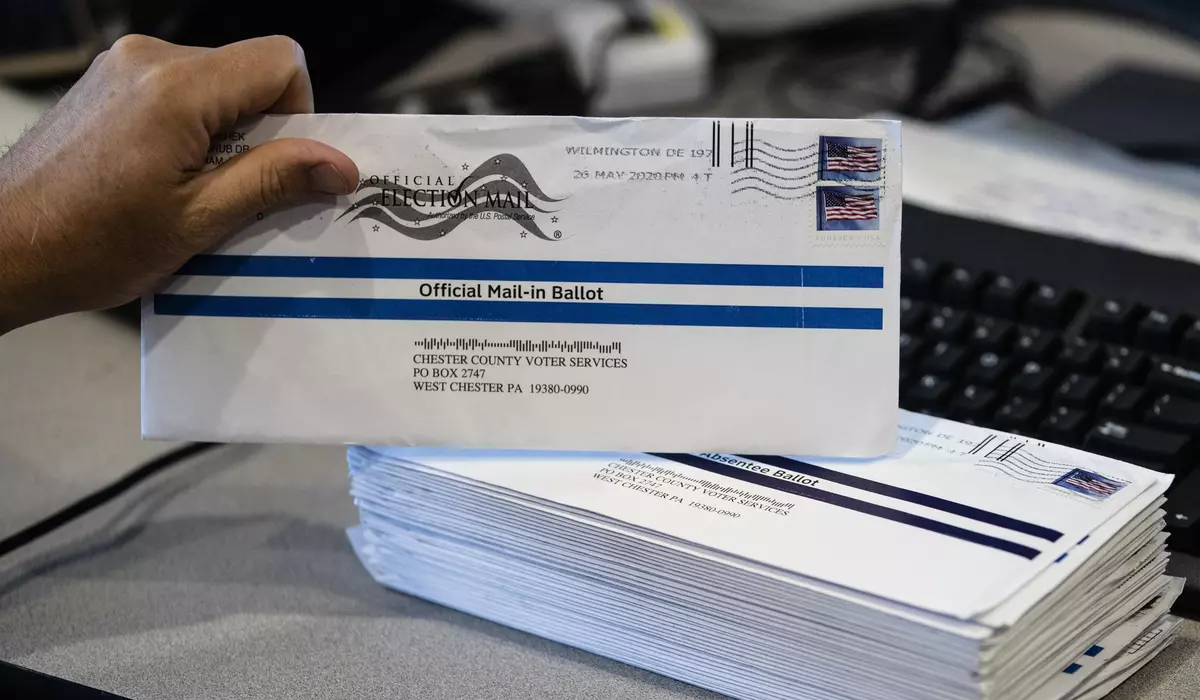
The legislation would also curtail the ever-expanding allowance of mail-in ballots in federal elections. Casting ballots by mail would be allowed only in cases of illness, disability, military deployment and travel.
“There is no excuse for a politician, or otherwise, to be against the above three requirements. There is only one reason to oppose — CHEATING! “ Mr. Trump said.
The majority of states allow “no-excuse” mail-in ballots, and eight states send a ballot to every eligible voter, which has raised concerns about election fraud. In 14 states and the District of Columbia, ballots are counted up to two weeks after Election Day if they are postmarked by Election Day.
SEE ALSO: Supreme Court allows mail-in ballots to be counted days after Election Day
The extended grace period has dragged out ballot counting in some states. In California, it took officials more than a week to count enough ballots for winners to be determined in the state’s June 2 gubernatorial primary.
Advocates of the grace period say it ensures everyone eligible to vote can participate in elections, but critics say it undermines public faith in elections. In Illinois, for example, ballots postmarked by Election Day are counted for an additional two weeks.
Read more UC Berkeley is establishing the Nancy Pelosi Institute to address democracy’s challenges
Mr. Trump views mail-in ballots as one of the main reasons the 2020 election did not turn out in his favor and led to his claim that the outcome was rigged in favor of President Biden.
Republicans and the president have sought to rein in grace periods for ballot-counting. In many cases, the extended tallying of mail-in ballots has favored Democratic candidates.
The Republican National Committee sued Mississippi in a bid to end the state’s practice of counting ballots postmarked on Election Day and received up to five days later.
The Supreme Court heard arguments in March and, in a blow to the GOP, handed down a 5-4 decision that nothing in federal election law “requires ballots to be received by election day.”
Justice Samuel A. Alito Jr., writing for the minority, said the decision handed down by the court does not align with Election Day statutes, election law principles or historical practices.
“It opens up and fails to resolve a host of questions for state election officials and courts. And it creates a serious risk of further undermining public confidence in our elections and our system of self-government,” Justice Alito wrote.
The ruling left Mr. Trump determined to cajole Congress to pass the SAVE Act, despite opposition from a handful of Republicans who would make it difficult to pass. In protest of the stalled bill, Mr. Trump has refused to sign bipartisan housing reform legislation and won’t allow his nominee for Director of National Intelligence, Jay Clayton, to appear before the Senate for a confirmation hearing.
“In a time when there is a powerful Communist Movement taking place in our Country, one more dangerous than World War I, World War II, Pearl Harbor, or September 11th, all Dumocrats, and our five Republican Senate Hold Outs, Lisa Murkowski, Susan Collins, Thom Tillis, Bill Cassidy, and Mitch McConnell must vote to SAVE OUR COUNTRY,” Mr. Trump said. “There are no more excuses!”
Read more Supreme Court says police need warrants for ‘geofence’ searches to track cellphones near crimes
About the Author