American warfighters equipped with the latest technology increasingly find themselves grappling with an endless sea of information — so much so that the U.S. military needs new tools to cut through and make sense of the data overload.
Read more Justice Dept., DHS plan crackdown on ‘birth tourism’ after Supreme Court citizenship ruling
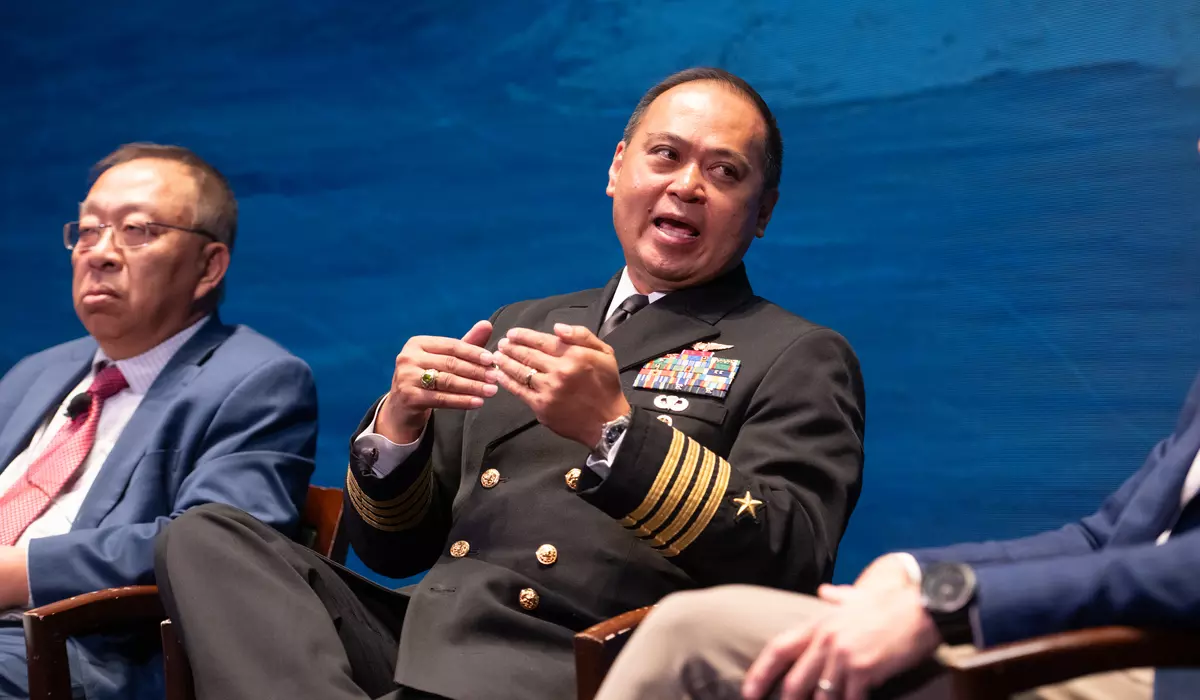
Capt. Randy Cruz, the commander of the U.S. Naval Research Laboratory, told an auditorium full of defense industry leadership last week that the lab he commands needs partners to help the military achieve what he called “decision superiority.”
His comments came during the IndoPac 2026 | Naval Dominance: Shipbuilding, Autonomy & C2 forum hosted by The Washington Times’ Threat Status national security team.
Capt. Cruz highlighted how the military is “now becoming inundated with information,” during a panel focused on command and control. Command and control is the military’s description of how to use communication and planning to ensure the military is able to accomplish its mission.
Hurdles for development often involve both cognitive and technical challenges as systems designed to bridge communications gaps meet the reality of service members needing to operate them.
The Pentagon’s upcoming funding request to Congress includes $19 billion for command and control to both develop new technologies and support current military systems, according to Obviant, a Virginia-based firm that uses data analysis and artificial intelligence to track military spending.
The new developments have quickly changed the landscape for service members.
“If I go back to my earlier command-and-control days, I think of that kid with a stick and a knapsack on the back. That was command-and-control going camping,” Capt. Cruz said. “Today it’s that SUV with stuff hanging off the rafters. That’s command and control today.”
Streamlining the methods of processing all of the information available into a usable picture is something he welcomed the crowd to engage with the laboratory on, saying that patents and licenses for cutting-edge technology are “available for industry right now.”
That kind of collaboration is now baked into how the lab operates, he said. “The days are long gone where it’s just the government only.”
Read more Baby photo of Hitler found in N.J. middle school yearbook, prompting recall
A goal of the U.S. Navy’s development is to have a web of communication across the service that allows all information to be shared quickly and easily between sensors (equipment meant to collect intelligence and find an enemy) and effectors (the equipment able to actually fight back in some way).
But, the vast amounts of information that new technology makes available presents a problem. While it helps show service members the reality on the ground, it often makes decisions more difficult and pushes against the cognitive load a leader can take on.
“Information is only good in two cases, right? Its content and its timeliness,” Capt. Cruz said. “The resilience and low latency to maintain or gain that decision superiority … that’s where the fight’s happening.”
He said that while the challenge of large distances in the Pacific can be difficult for communications, being able to make decisions quickly and effectively is much more important.
“How do I master and gain that decision superiority? That’s the key,” he said.
Capt. Cruz said the laboratory is working on the data challenges the U.S. Navy is encountering but needs to continue to involve its solutions in real-world testing.
“We’ve got the Naval Center for Applied Research for AI, and they’ve been around since the early 80s, and they’ve been developing things like SAGE, the Sentry Agentic Framework,” he said.
He described it as an AI environment, where systems can ”kind of talk to each other” to help bring together all the different types of information into a command-and-control system and make it manageable for a service member to use.
“We’re realizing that there’s all this information and the challenge is… although we develop these fixes, is getting the opportunity — and we do get the opportunity when we have these exercises — to exercise and see how they work,” he said.
Read more E. Jean Carroll’s lawyers request Trump pay $5.8 million verdict: ‘Time for this case to end’
About the Author