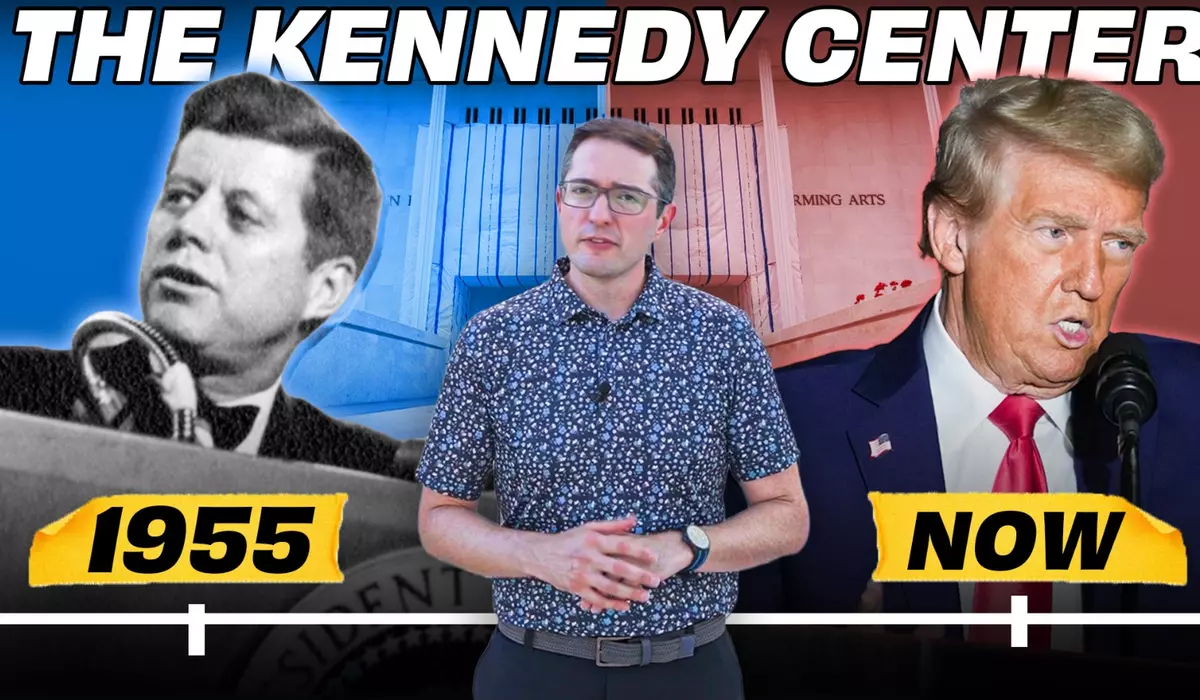
The Kennedy Center’s future is caught in a court battle over renovations, leadership, and its name. George Gerbo breaks down how a two-year closure plan and a board takeover ended up in front of a federal judge — and what comes next for the nation’s cultural landmark.
Read more Trump to attend dignified transfer of American soldiers killed in Iran conflict
Will the Kennedy Center stay open?
That sounds like a simple question, but right now, the answer depends on who you ask. And, as you can see behind me, there’s not much activity going on. After months of canceled shows, political upheaval, and a planned two-year renovation, the Kennedy Center is now caught in a court battle over one of Washington’s most famous cultural landmarks.
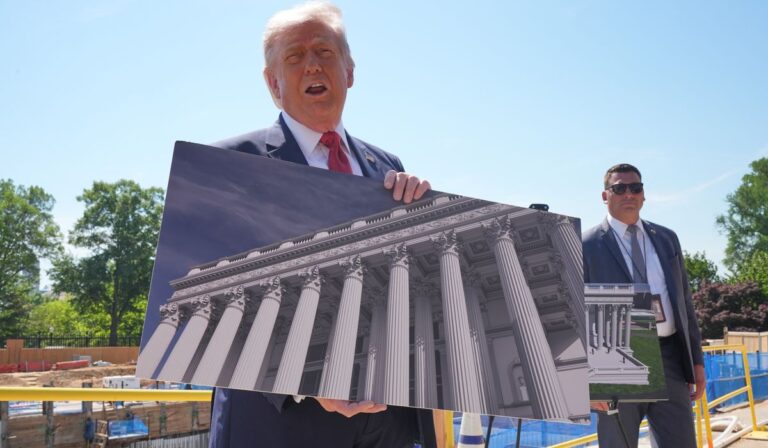
Over the past year, President Trump has moved to remake the Kennedy Center from the top down, reshaping its leadership and pushing the institution in a new direction. The shakeup was followed by staff cuts and departures, Trump’s name being added to the building, and eventually a plan to close the center for two years of renovations. Then a federal judge stepped in. District Judge Christopher Cooper blocked the two-year closure, ordered Trump’s name removed from the facade, and said the center could make necessary repairs but not shut down programming altogether.
Now Trump’s name has come down, though the spot where it was is covered by tarp and scaffolding.
What began as a fight over renovations has become a test of presidential power.
So how far can Trump go in reshaping a memorial to John F. Kennedy? Do Congress or the courts have the power to stop him? And what’s next for the Kennedy Center? I’m George Gerbo, and this is The Brief. Let’s dive in.
The idea for a performing arts center for the country actually predates Kennedy’s presidency. In 1955, President Dwight Eisenhower established a commission to consider a new public auditorium here in Washington. In a letter to Congress, Eisenhower said there had “long been a need for more adequate facilities in the nation’s capital for the presentation of the performing arts,” and called the building “a center of which the entire nation could be proud.”
The National Cultural Center Act was passed by Congress and signed by Eisenhower soon after in 1958. Administered as part of the Smithsonian, the law stipulated the center would be built with voluntary, not government contributions. The center would be run by a board of trustees made up of a group of public officials, elected representatives, and others. More on that board in a minute.
The law originally set a five-year timeframe to raise the funds for the building. If the money wasn’t collected, then the project would be canceled. In 1962, President Kennedy, along with his wife Jackie, launched a $30 million fundraising campaign to finally build the center. At a televised fundraiser for the effort that year, Kennedy said, “Art knows no national boundaries. Genius can speak in any tongue, and the entire world will hear it and listen.”
As the law’s original five-year deadline approached in 1963, Congress passed and Kennedy signed an amendment, which both extended the deadline three more years and doubled the size of the board from 15 to 30 members. President Kennedy was assassinated in November 1963, and the shocking event quickly crystallized Congress, which was moved to honor JFK and his devotion to advancing the arts.
The John F. Kennedy Center Act passed and was signed into law just two months later, renaming the center and allocating an additional $15.5 million for the project. Construction finally began in 1966, and the Kennedy Center opened in 1971.
Now with a massive building that includes multiple theaters, what programming would be available to the public?
The Center’s foundational law serves as a guide. Section 4 of the National Cultural Center Act says the Kennedy Center Board shall present classical and contemporary music, opera, drama, dance, and poetry, present lectures and other programs, and develop programs for children and the youth and the elderly. But in recent years, President Trump and some Republicans have said the center’s programming hasn’t appealed to a broad enough group of Americans. In his first term, Trump notably skipped the 2017 Kennedy Center Honors, and a White House reception was canceled after some of that year’s honorees took exception to events during his first year in office.
Fast forward to 2025. After being reelected to a second term, Trump began to more forcefully remake parts of Washington, D.C., structurally and culturally. Shortly after returning to office last year, Trump ousted the center’s previous leadership and replaced it with 18 new hand-picked members that are administration officials or political allies, including Second Lady Usha Vance, White House Chief of Staff Susie Wiles, and Deputy Chief of Staff Dan Scavino. Trump also brought in Richard Grinnell, who doesn’t have a background in the arts, but served as ambassador to Germany and acting National Intelligence Director during Trump’s first term to lead the Kennedy Center’s day-to-day operations. Trump’s newly constructed board then appointed Trump as its chairman.
Read more Marco Rubio exposes radical leftism’s violent core
This was unprecedented. No previous president had served as Kennedy Center board chair. A few months later in December, the board voted to rename the institution the Trump Kennedy Center.
Ticket sales declined and artists began canceling their affiliations and planned shows in wake of the administration’s moves. Musician Ben Folds, who was an artistic advisor to the National Symphony Orchestra, said the new direction was “not for me.” And the producers of the hit Broadway musical Hamilton canceled a run that was to be timed at the center for the nation’s 250th birthday, saying a spirit of nonpartisanship had been violated. Grinnell called that move a publicity stunt.
Then in February came another seismic decision. Trump announced on social media a construction, revitalization and complete rebuilding of the center to the tune of $257 million, which would require the building to be closed for two years. The board approved the closure March 16th. An official conducted a tour of the building for reporters, showing degrading concrete and rebar in the parking garage and rust discoloration on the marble facade.
The thought of closing the nation’s signature performing arts facility for such a long period of time proved to be an inflection point in the battle for its soul.
Five days after the board’s closure vote, a group of eight cultural and historic preservation groups filed a lawsuit. That suit was mirrored by one from Ohio Congresswoman Joyce Beatty. She sued in December after Trump’s name was added and she wasn’t allowed to vote on the change. Why would she be? There are 23 ex-officio members of the Kennedy Center’s Board of Trustees designated by an act of Congress. They consist of specific federal officials like the Secretary of State and the Librarian of Congress, local D.C. leaders, and appointed congressional members. Beatty, a Democrat from Ohio’s 3rd District, is one of those appointed members. She said during the conference call when renaming the center was discussed, participants’ microphones were muted and they weren’t given a chance to address their concerns.
Both cases came before Christopher Cooper, the U.S. District Judge for the District of Columbia. In twin rulings on May 29th, Cooper, who was appointed by President Obama in 2014, provided his answers. He blocked the two-year closure, saying numerous construction budget line items are too vague to fully interpret what would be done and that the precise nature of the construction is shrouded with uncertainty. Renovations could continue if more specific details were provided, Cooper ruled, but the center’s programming couldn’t be completely shuttered during that period.
In answering Beatty’s complaint, he ordered Trump’s name removed from the center and the facade behind me. Cooper found the renaming unlawful, pursuant to Congress’s action to designate the center as a living memorial to JFK, writing, “Congress gave the Kennedy Center its name, and only Congress can change it.”
The administration was given 14 days to comply with the name removal and submit sworn proof of compliance to the court. The Board of Trustees tried a last-ditch effort to stay the decision, but it didn’t work. On June 12th, workers removed Trump’s name as those in support of the move gathered to cheer them on. The striped tarp behind me then went up over where Trump’s name was, but later photos still show its removal.
So what is the future of this American institution?
Cooper asked the Center for its plans for public access and other programming beyond July 5th, when the proposed renovation was to have started. The Kennedy Center responded, saying it’s not required to schedule shows that had been canceled during the planned renovation period, but that it plans to maintain an operational model. As a living memorial, the public is able to go inside and walk around the lobby areas to explore, just as you can at other memorial sites in Washington.
But there’s more questions than answers. The NSO, one of the Kennedy Center’s main tenants, isn’t scheduled for any concert hall performances in the near future, but is maintaining its annual summer residency at Wolf Trap National Park for the Performing Arts in Northern Virginia. And the Washington National Opera announced in January it was moving productions from the Kennedy Center’s Opera House, ending a 15-year partnership “at the Kennedy Center’s own suggestion.” The opera is also suing to force the Kennedy Center to turn over more than $17 million in withheld donations.
It leaves this beloved cultural icon in limbo on multiple fronts. Its board has acted in the interest of the president, but is restricted from major actions by the courts. Artists and performances have canceled signature shows. And while there have been calls for a wider variety of programming, the process of bringing in new artists and genres has yet to find its footing. Together, those factors suggest the Kennedy Center may be working to rebuild its reputation for years to come.
Read more Trump says Netanyahu won’t be arrested in U.S., rebuffing Mamdani’s threat
Read more:
- Appeals Court rejects Trump’s last-ditch bid to keep his name on the Kennedy Center
- No Trump, no money: DOJ says Kennedy Center faces ‘financial ruin’ without president’s name
- Kennedy Center eyes ‘partial closure’ after judge blocks full shutdown for renovation
- Tarp still covering facade of the Kennedy Center after Trump’s name was removed
- Judge blocks closure of Kennedy Center, takes Trump’s name off iconic building
- Democratic lawmaker asks judge to take Trump’s name off Kennedy Center
- Trump says Kennedy Center renovations will cost $200 million
Get more episodes of The Brief with George Gerbo
About the Author