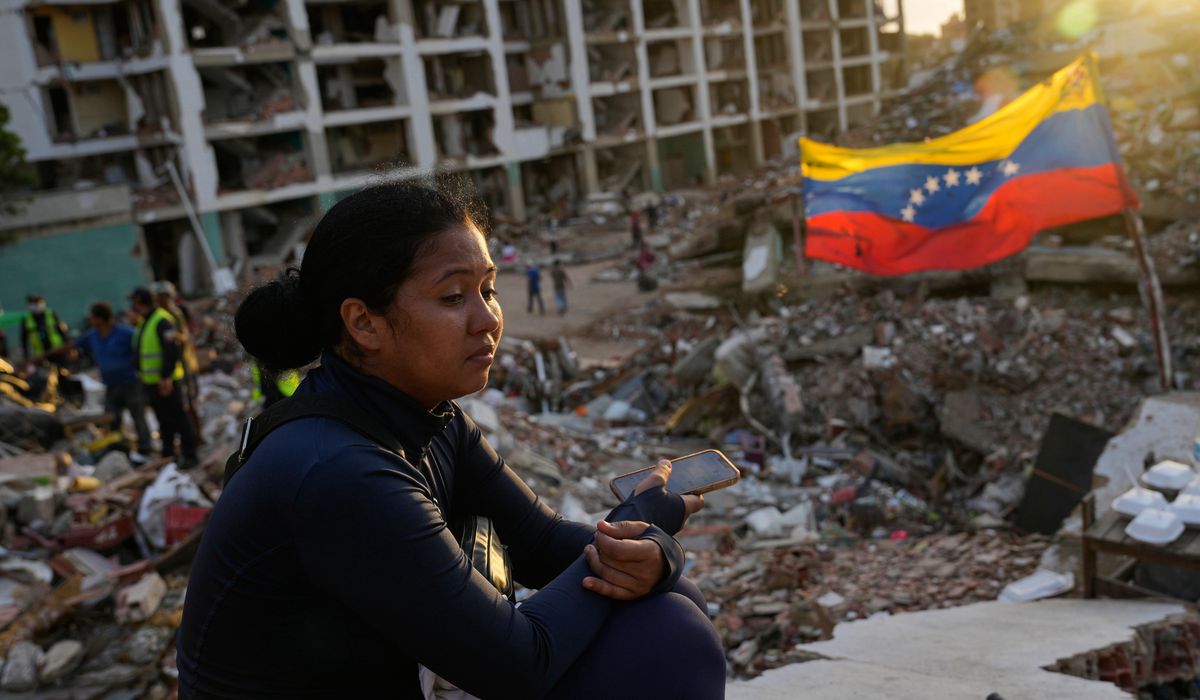
The U.S. Department of Agriculture has been coordinating food security efforts in Venezuela after twin earthquakes devastated the country last month, according to a senior official, part of Washington’s broader humanitarian footprint in the Latin American nation since the Trump administration captured former President Nicolas Maduro in January.
Read more USDA oversees earthquake relief effort in Venezuela, expanding American footprint post-Maduro
Luke J. Lindberg, undersecretary of agriculture for trade and foreign agricultural affairs, detailed those efforts in an exclusive interview with The Washington Times, describing an administration dedicated to Venezuela’s recovery. Mr. Lindberg headed a delegation that has been distributing food, supplied by the State Department, and inspecting relief hubs on the ground, as USDA and State work alongside other agencies on the broader response.
“The United States has played the clear and definitive leader in this response,” he said.
Mr. Lindberg described the initiative as a “whole-of-government approach,” incorporating entities such as the Global Empowerment Mission, Samaritan’s Purse, the World Food Program and the United Nations.
He pointed to one recent example to illustrate the scale of U.S. involvement: “You even saw a news story breaking earlier this week that another country sent a planeload of aid to Venezuela, and the United States military was the one that actually offloaded the aircraft and helped to distribute the materials on the ground,” he said.
“So U.S. leadership has been critical, and will continue to be critical here in the months ahead,” Mr. Lindberg added, “but very committed to making sure that it is transitioned effectively back to Venezuelans at the appropriate moment in time.”
Two earthquakes rocked Venezuela on June 24, registering magnitude 7.2 and 7.5 — the strongest to hit the country in more than a century. Venezuelan officials have reported roughly 3,800 people killed and more than 16,700 injured. Tens of thousands have been displaced after more than 250 buildings were damaged or destroyed across the country’s densely populated urban areas, with hundreds more buildings left structurally unsound.
Read more Judge says Paramount and Warner must halt merger for at least two weeks, granting states’ request
In the immediate aftermath, the State Department pledged $150 million in humanitarian aid, split between a $100 million contribution to a U.N. fund and $50 million for organizations already operating in the country. Secretary of State Marco Rubio told reporters Sunday, ahead of his trip to Manila for meetings of the Association of Southeast Asian Nations, that the U.S. commitment has since grown.
“It’s already upwards of $180 million, and we’re looking — we’ll do more. The Venezuelans will do more,” Mr. Rubio said. “We’re trying to help them get access to global funding and credit as well for their rebuilding. They’re still working through an estimate on the total cost, and it’ll be substantial.”
Since Mr. Maduro’s capture in January, his former vice president, Delcy Rodriguez, has served as acting president for roughly six months. She has reportedly worked closely with U.S. officials, including Mr. Rubio, and President Trump has repeatedly praised her performance in reopening the country to foreign investment.
Mr. Rubio has cast U.S. involvement in Venezuela as a phased process — stabilizing the country, aiding its recovery, and eventually helping it transition to a functioning democracy after years of authoritarian rule. Mr. Lindberg echoed that framing, saying the U.S. does plan to shift control back to Venezuela once certain conditions are met, though he did not share specific metrics the administration is using to determine when that handoff should occur.
Still, Mr. Rubio has signaled the relationship has limits. He told Congress earlier this year that the U.S. is “prepared to use force to ensure maximum cooperation if other methods fail.”
Correction: A previous version of this article incorrectly described USDA’s role in Venezuela’s earthquake relief effort. USDA oversaw food security efforts; the food itself was supplied by the State Department.
Read more More than 100 senior PLA officers purged for corruption, says Air Force think tank report
About the Author