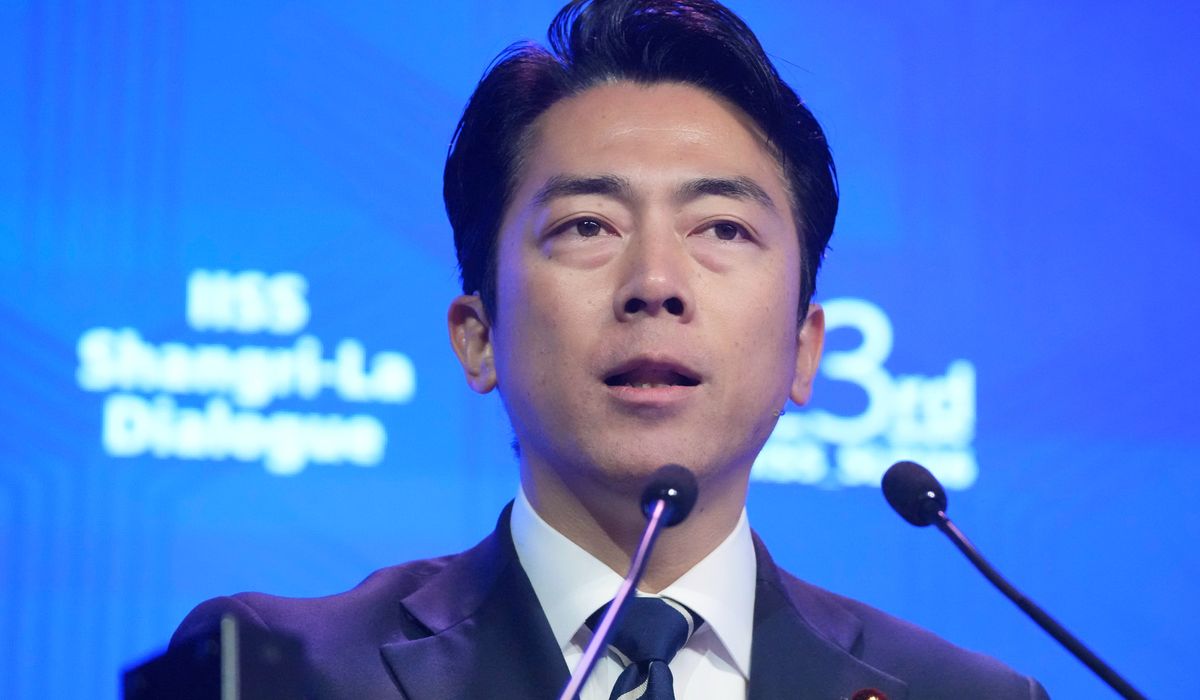
SEOUL, South Korea — Japanese Defense Minister Shinjiro Koizumi has urged his countrymen to openly debate whether nuclear weapons have a role in Japan’s defense, a move unthinkable in the pacifist-leaning nation just a few years ago.
Read more Platner ally Troy Jackson stepping in to take on Sen. Susan Collins
Mr. Koizumi, one of the higher-profile members of the hawkish Cabinet of Prime Minister Sanae Takaichi, is overseeing an expansion of defense ties across the Indo-Pacific amid growing Japanese concerns about China’s aggressiveness and America’s reliability.
“While this is a difficult issue for Japan to discuss, one topic we cannot avoid is nuclear weapons,” Mr. Koizumi said during an online broadcast that was widely reported by Japanese media over the weekend.
On Monday, China rebuked Mr. Koizumi’s nuclear trial balloon. Over the weekend, a Chinese warship conducted naval machine gun drills inside Japan’s 200-nautical-mile economic exclusion zone.
Neither move looks likely to alter Japan’s direction of travel.
For decades after World War II, pacifist Japan was reluctant to speak or move forthrightly on defense. Since a reinterpretation of its constitution in 2014-2015, however, Japan has been beefing up its offensive assets, including acquiring F-35 carriers and Tomahawk cruise missiles.
Now it is expanding defense and defense industrial relationships beyond traditional ally Washington.
Star politician speaks out
In his comments on nuclear weapons, Mr. Koizumi cited France and Finland. Mr. Koizumi said France is expanding and dispersing its nuclear arsenal and offering protection to NATO allies. Finland last month voted to lift its ban on hosting nuclear weapons on Finnish soil, allowing allied nuclear arms for defensive purposes.
Nuclear-armed China offered a testy response Monday.
“If the Japanese authorities stick to their miscalculations on the nuclear issue, push to revise the Three Non-Nuclear Principles and deploy allies’ nuclear weapons in Japan, they … also breach their commitment to peace, defy what the Japanese people want, and will eventually pay a heavy price,” a Foreign Ministry spokesperson said.
Tokyo’s three principles are to not manufacture, possess or allow deployment of nuclear arms on Japanese soil.
Mr. Koizumi, 45, is the son of Junichiro Koizumi, 84, Japan’s prime minister from 2001 to 2006. Youthful by Japanese political standards, the defense minister is a political high flyer, noted for good looks and fluent English. Widely seen as a future prime minister, he is not considered an ultranationalist, unlike some members of Japan’s right.
“I think he is pretty moderate, and that makes it a bit easier for him to talk about this,” said Paul Midford, a professor of political science at Meiji Gakuin University.
Mr. Koizumi’s youth may matter. Younger Japanese, lacking memory of the horrors of World War II, are less pacifist than their grandparents.
“This is something that a politician or defense minister could not have got away with 20 years ago,” Mr. Midford said.
Mr. Koizumi is not the first member of the Takaichi administration to raise the nuclear issue. In December, an unidentified defense specialist made the front pages after opining that Japan needs nuclear arms.
Nuclear weapons are an acutely sensitive topic in Japan, the only nation ever to have been on the receiving end of the bomb.
In August 1945, Hiroshima and Nagasaki were vaporized by U.S. forces seeking to end World War II without invading Japan’s main islands.
Now, cautious approval of Mr. Koizumi’s suggestion is widespread in Japan.
“The nuclear taboo has been strong to the point there’s been no serious debate on even U.S. nuclear strategy,” said Haruko Satoh, a specially appointed professor at Osaka University’s Osaka School of International Public Policy. “That’s the problem.”
“We have had a nuclear allergy for so long, and I think he represents a new generation of thinking in Japan,” said a Japanese academic who spoke on the condition of anonymity as he serves as a government consultant. “I don’t think he is pushing for nukes, per se.”
Both the academic and Ms. Satoh guessed that any upcoming debate would focus on stationing U.S. nuclear weapons in Japan, rather than acquisition.
It is widely anticipated that Tokyo will revise its three key national security documents this year. That, however, does not necessarily signal Ms. Takaichi’s intention to initiate changes to the pacifist Article 9 of the Japanese Constitution.
“In March, she went to D.C. and, like many prime ministers before her, used Article 9 to prevent Japan being dragged into a U.S. war,” said Mr. Midford, referencing the Iran war. “The article is useful for managing Japan’s relations with the U.S.”
Japan lives in a tough neighborhood
China’s regional assertiveness, Russia’s invasion of Ukraine and North Korea’s nuclear arsenal all fuel fears about an increasingly threatening security environment.
Japanese defense rests on the bedrock of its alliance with the U.S. and its protective nuclear umbrella.
Read more Trump warns Houthi rebels not to block Red Sea ports and grapples with Hezbollah in Lebanon meeting
The Trump administration has urged its allies to increase defense spending and play larger security roles. However, President Trump’s unpredictability has alarmed some capitals concerned about reliability.
Those fears are acute in NATO, and polls in Japanese neighbor South Korea find a strong majority there that favors a sovereign nuclear deterrent.
Tokyo officialdom is discreet. However, it is prudently expanding defense ties beyond its core ally.
Looking beyond Washington
Mr. Koizumi is in London this week to attend ministerial-level talks on the Global Combat Air Program, or GCAP.
That project, initiated in 2022, unites Italy, Japan and Britain in the design and construction of a sixth-generation stealth fighter. Japan’s biggest overseas joint defense project has recently received a slew of good news.
After uncertainties about British funding, London, in late June, committed approximately $11 billion to GCAP over four years, to the relief of Rome and Tokyo.
Referring to Japan’s three defense attaches in London, Mr. Koizumi posted on his X account, “It’s a relief to see all three of them looking well and healthy” — adding “including GCAP.”
On Tuesday at the Farnborough International Airshow, near London, Mr. Koizumi was present as Canada officially joined GCAP as an observer nation.
“While Canada won’t have a decision-making role, the move gives them privileged access … and paves the way for discussions on Canada’s future participation and contribution,” the British Ministry of Defense said in a statement.
Japanese media reckon GCAP offers the opportunity to acquire “advanced technological know-how outside the framework of its alliance with Washington.”
“This is no surprise: The U.S. is not generous in sharing technology,” Mr. Midford said, but added: “There are some questions about how GCAP will unfold; some say it is basically a half-assed attempt, as the critical tech the U.S. has is not part of it.”
Still, value is not solely industrial.
“We have a new framework of working with partners outside the U.S.,” Mr. Midford said. “This is not a 180-degree turnaround, but it’s opening things up.”
Other developments are regional.
In April, Tokyo completed the lifting of its ban on lethal weapons exports, a process begun with a 2014 partial easing, and announced the sale of 11 stealth frigates to Australia.
After Mr. Koizumi met with his Vietnamese counterpart in Tokyo on July 13, talks got underway on developing joint landing craft.
Plans are also in process for Japan to hand over three to six used destroyers to the Philippines.
Japan, the Philippines and Vietnam have shared interests.
Hanoi and Manila are confronting Beijing’s navy, coast guard and maritime militia — centrally directed, weaponized fishing fleets — in the South China Sea.
China and Vietnam fought a sea-land battle in 1988; landing craft are ideal for retaking lost territory. The Philippines lacks destroyers. Its current fleet deploys corvettes and frigates.
In the East China Sea, Japan’s Coast Guard is holding the line in the disputed Senkaku Islands, which China claims as the Diaoyus.
In November, Mr. Koizumi gave a press conference on Yonaguni Island, where Japanese-U.S. military presence is expanding. Yonaguni is the closest Japanese island to both the Senkaku Islands and Taiwan.
With Chinese naval task groups ranging ever further afield, Mr. Koizumi’s horizons may expand to an even more distant island.
Mr. Midford expects revisions to Japan’s three core national security documents to include mention of Ioto Island, in the blue-water Pacific.
That volcanic isle, some 750 miles south of Tokyo, is strategically positioned to monitor Chinese naval movements. It is better known to Americans by its older name: Iwo Jima.
Read more Alan Dershowitz backs out of Epstein hearing, sparking subpoena threat
About the Author