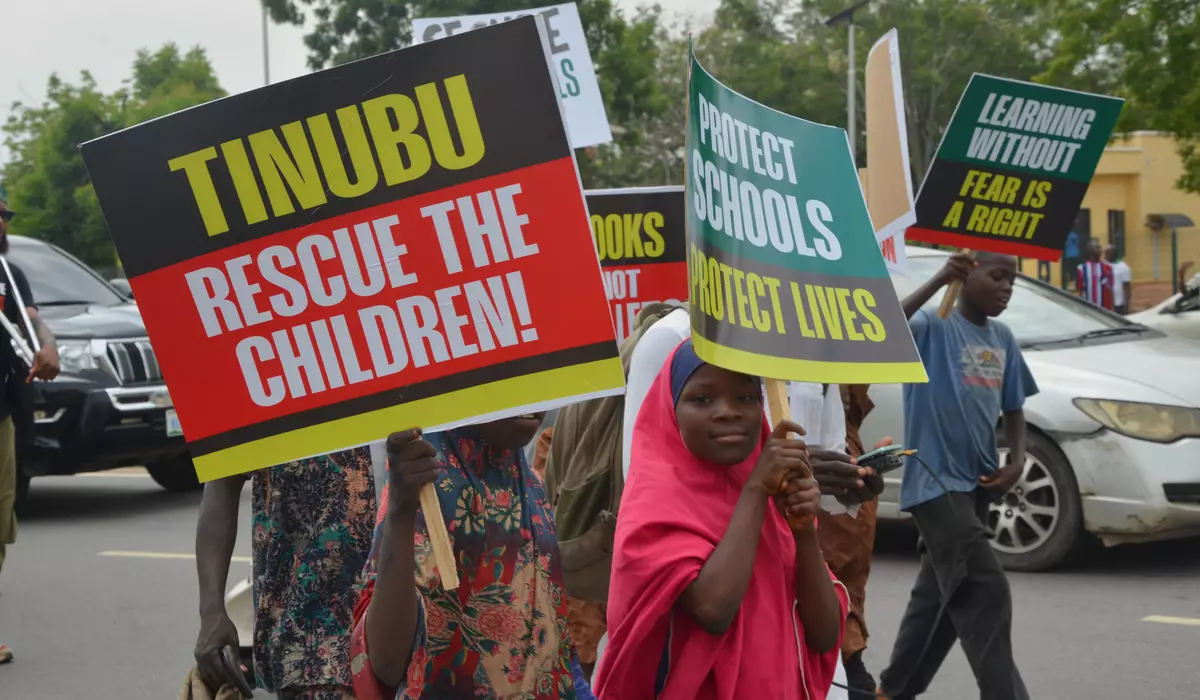
JOHANNESBURG — Thankful families this month celebrated the July 10 rescue of 46 abducted people, including 39 schoolchildren and several teachers, by Nigerian security forces, but the latest progress in embattled Nigerian President Bola Tinubu’s three-year war on Islamist militants may be too little too late for some American lawmakers.
Read more Airports in Tampa, Des Moines and Charleston opt for TSA privatization screening program
The House last week approved a measure that would cut all aid to Nigeria until the Tinubu administration steps up its efforts to protect the West African nation’s Christians from Islamic extremists.
The amendment, approved by a voice vote, was added to the fiscal 2027 State Department spending bill that later passed by a 217-209 vote along mostly party lines.
Rep. Gregory Steube, the Florida Republican who sponsored the amendment, said U.S. taxpayers should not be expected to fund a “corrupt” Nigerian government that has failed “to meet its fundamental obligation to protect citizens” and allowed extremists to operate “with impunity.”
The amendment has neither Senate nor White House backing yet, but its passage in the House is one measure of growing concern and outrage in the U.S. over the wave of religious violence in Africa’s most populous nation, where Christians make up nearly half the country’s 234 million people and Muslims account for roughly 52%, according to Pew Research.
Mr. Trump ordered Christmas Day airstrikes on Islamic State militants in northwest Nigeria and then followed up with an announcement in February of 200 additional U.S. military personnel assigned to train and advise the Nigerians.
Christian and Muslim clerics led celebrations on July 17, according to The Associated Press, in the village of Esinele, where dozens of children, most of them Christian, were abducted from three schools in May by the Ansaru militant group, an offshoot of Boko Haram.
“We have all come here to thank God for protecting the children and their teachers and helping the military men who rescued them,” traditional ruler Tajudeen Abioye told the wire service.
As violence escalates, a recent study showed Christians were killed at roughly 4.4 times the rate of Muslims by militants in the six years before September 2025.
According to the report by the Observatory for Religious Freedom in Africa, an estimated 10,500 Muslims were killed in religious violence during the six-year period, while 23,000 Christians were killed by religious extremists.
Since its independence from Britain in 1960, Nigeria has struggled against secessionist groups and ethnic and religious violence.
In 1967, the mostly Christian Igbo declared themselves independent as the nation of Biafra, triggering a civil war and severe humanitarian crisis. Although numbers are disputed, estimates range from 500,000 to 3 million total deaths from combat, famine and disease.
Read more Democrats battling over presidential primary calendar for 2028
Today, the war is against extremists in the north who seek to establish a caliphate.
The battle has touched other parts of Africa, spreading across the Sahel to neighboring Niger and Mali, and south to the former Portuguese colony of Mozambique, where ISIS is waging a war, also in quest of a caliphate.
Of Africa’s 55 nations, 18 are Muslim-majority. Others, such as Ghana and Kenya, are predominantly Christian but have freedom of religion, with mosques and churches often coexisting.
In South Africa, Hindu temples and Jewish synagogues abound. For the most part, communities get on well.
Nigeria made headlines in 2014 when Boko Haram kidnapped 276 girls, most of them Christian, from a school in the northern town of Chibok.
A global campaign ensued. The United Nations and other groups demanded the release of the children.
Some of the girls escaped, and others were released in exchange for prisoners. Many are still missing, and returnees told of rape, beatings and forced conversion to Islam.
The Observatory for Religious Freedom in Africa makes clear that the problem has only grown worse, warning that extremists are motivated by radical Islam but also a quest for resources. Tribal rivalries are serious, notably among the Fulani people who make up less than 10% of the population.
Frans Vierhout, a research analyst at the observatory, said the group’s latest data “looked at how killings occurred, who they target, where they operate, seasonal fluctuations. And the evidence points strongly in one direction.”
Violence linked to Fulani militias is the real force fueling Nigeria’s death toll, he said, adding that “the Western preoccupation with Boko Haram is, at best, misleading.”
The country, he said, was “incubating a terror network” as yet unacknowledged by the world.
Read more Trump fetes Dodgers at White House again, calls team ‘one of the great brands’
About the Author