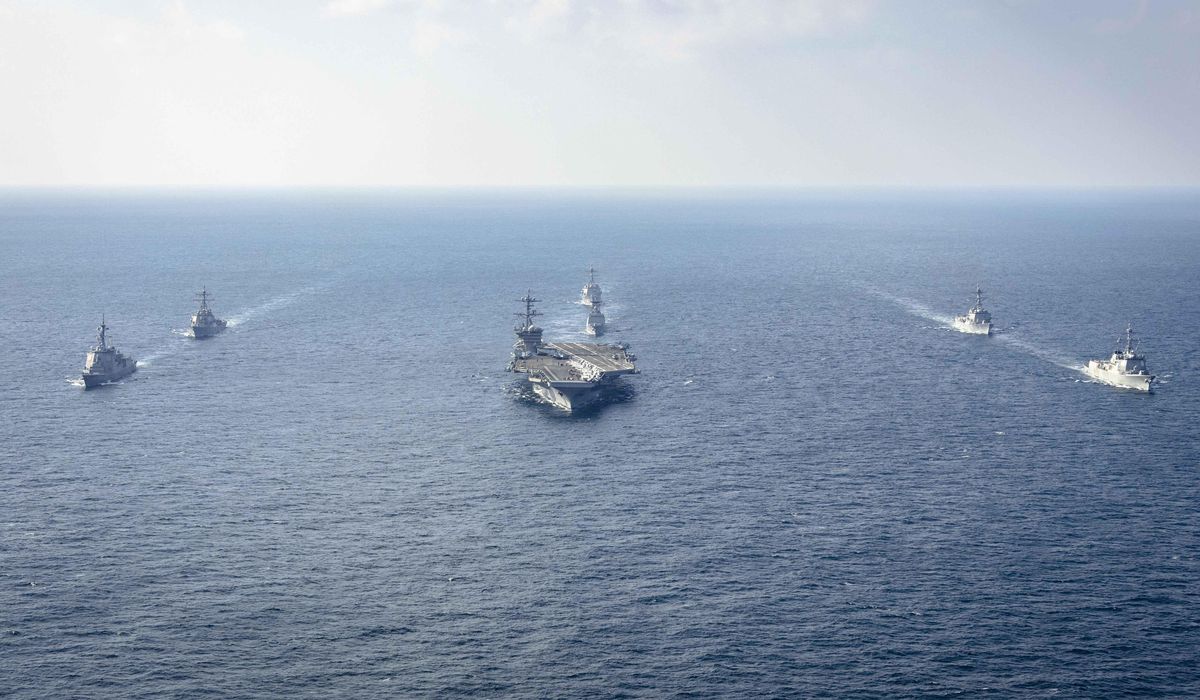
The Navy deployed an aircraft carrier strike group to the contested South China Sea amid growing tensions between U.S. ally Philippines and China, according to U.S. officials.
Read more Oregon governor warns migrants to be wary of ICE impersonators
U.S. Ambassador to the Philippines Lee Lipton said on social media that the USS George Washington and its advanced F-35 jets are “upholding FREEDOM of Navigation and Overflight in the South China Sea.”
“We challenge excessive maritime claims around the world,” Mr. Lipton stated on X Sunday.
The deployment comes after a recent confrontation between Chinese coast guard ships and Philippine vessels in the sea that resulted in injuries to a Filipino seaman along with a harsh denunciation by the State Department of Chinese maritime bullying.
The Chinese coast guard injured a Philippine service member during a clash July 20 near the Philippines-occupied Second Thomas Shoal.
Philippines military personnel from a grounded naval vessel being used as a base at the shoal had launched two inflatable boats to intercept Chinese coast guard vessels when the confrontation took place.
Video released by both nations showed the boats colliding and personnel hitting each other with oars and batons in a confrontation that left one Filipino with a head wound.
Joint diplomatic protests were issued and the State Department condemned the Chinese role in the incident.
Second Thomas Shoal is a submerged reef inside Manila’s internationally recognized exclusive economic zone but the waters are claimed by China.
The incident took place days after the 10th anniversary of an international tribunal ruling in favor of the Philippines that declared China’s claims to most of the South China Sea illegal.
China has ignored the legal ruling and continues to assert that a vaguely defined nine-dash line forms its maritime territory over the sea.
State Department spokesman Tommy Pigott said in a statement after the incident that the United States “condemns China’s dangerous and aggressive action” near the Second Thomas Shoal and that Washington urges Beijing to immediately halt “destabilizing conduct.”
Philippines President Ferdinand R. Marcos Jr. spoke by phone with President Trump on Thursday and Mr. Trump told Mr. Marcos he would raise Manila’s concerns during his planned meeting with Chinese President Xi Jinping in September, according to a statement issued by the Philippines presidential office.
One day after the incident, Philippines military forces joined with Navy and Japanese military forces in conducting a joint patrol in the South China Sea.
The drills took place from July 21 until Saturday and included warships, coast guard vessels and surveillance and fighter aircraft in operations aimed at improving interoperability among the allies, the Philippine military said on Sunday, Reuters reported.
The military patrols highlighted “the enduring partnership among the partner nations in promoting peace, stability, and security in the Indo-Pacific region,” the military said in a statement.
China reacted to the drills with one of its vessels firing a water cannon at Philippine government vessels near the Scarborough Shoal on both Thursday and Friday, the Philippine coast guard stated.
China’s People’s Liberation Army criticized the joint patrols as an effort by the Manila government to “stir up troubles” by inviting countries outside the region to take part in joint military engagements.
The Philippine vessels included a guided missile frigate and two coast guard vessels. The Navy forces included the littoral combat ship USS Santa Barbara, an MH-60S helicopter and a P-8A maritime patrol jet. A Japanese destroyer also took part, highlighting growing Tokyo military support to the Philippines.
Read more Murder trial for Massachusetts mom Lindsay Clancy opens for strangulation of three young children
The drills included communication exercises, replenishment-at-sea operations, division tactics and fly-by operations, according to the Philippine News Agency.
The Philippines military said the exercises showed the three nations’ “enduring partnership” and the military’s commitment to freedom of navigation and overflight, while deterring what the Philippine military called “illegal, coercive, aggressive, and deceptive activities” in the South China Sea.
Tensions also remained high in the region following China’s launch of a nuclear-capable submarine-launched ballistic missile on July 6 from waters near the southern coast. The test missile flew more than 4,000 miles into the South Pacific and nearby the U.S. island of Guam.
The Navy’s Seventh Fleet announced the carrier’s transit from the Philippines Sea to the South China Sea on Thursday, stating that earlier flight operations in the Philippine Sea sought to “ensure our forward-deployed forces remain lethal and ready to respond to any contingency.”
The George Washington’s X account stated on Saturday that carrier helicopter operations in the South China Sea were “a thing of beauty.”
“USS George Washington #CVN73 is a visible & potent symbol of US commitment to the security & stability of the Indo-Pacific,” the posting said. “Our presence deters adversaries & reassures allies & partners!” the posting said.
Joining the flattop are the Navy cruiser USS Robert Smalls and destroyers USS Benfold and USS Shoup, according to the U.S. Naval Institute, a private group that tracks Navy carrier and warship deployments.
The Japan-based carrier left its based at Yokosuka, Japan on May 23 to the southern sea patrol. In June the carrier took part in Pacific exercises called Valiant Shield.
Further south from the carrier deployment, American warplanes currently are drilling with more than 100 combat and military aircraft from 21 allied nations, including Japan and Philippines, on the northern coast of Australia, as part of large-scale aerial exercises called Exercise Pitch Black.
Air Force F-35 jets, C-130 transports and KC-135 tankers are participating for the United States.
Other nations involved in the 2,500-personnel exercise include Japan, which dispatched its F-35s and E-2 electronic warfare aircraft, and Philippines, that sent F-50 jets.
Forces from Brunei, Canada, Fiji, Finland, France, India, Indonesia, Japan, Malaysia, New Zealand, Papua New Guinea, South Korea, Singapore, Spain, Sweden, Thailand and Britain also are taking part.
Australian Prime Minister Anthony Albanese said in kicking off the air drills July 19 that the exercises will build stronger relationships, a stronger Australian defense forces and a stronger secure region.
Retired Air Force officer Guermantes Lailari said the international exercises in northern Australia show that years of Chinese gray-zone bullying designed to fracture international coalitions have backfired.
“The strategic message for Beijing is simple: collective political will and decentralized combat capability are the only real-world antidotes to revisionist expansion,” Mr. Lailari said. “For a decade, China operated under the illusion that gray-zone bullying could isolate individual Indo-Pacific states. Pitch Black shatters that calculation completely.”
Retired Navy Capt. Jim Fanell said large international exercises near China like Pitch Black are valuable in countering increased Chinese aggression in the region.
“I’d like to see a huge naval exercise in the South China Sea — a RIMPAC West type of new exercise — or have it conducted east of Taiwan using ports in Taiwan and the lower Ryukyu ports to host all the allied shipping,” Capt. Fanell said referring to the Hawaii-based Rim of the Pacific drills. “For now, Pitch Black is a great step forward.”
Read more North Korea to deploy 30K troops to Russia, says Ukrainian President Zelenskyy
About the Author