President Trump on Monday struck an optimistic tone while touting the U.S.-Iran peace deal, predicting the yet-to-be-finalized agreement will transform the Middle East even as daunting questions remain about fighting in Lebanon and the future of Tehran’s nuclear program.
Read more B-52 Stratofortress crashes after takeoff at Edwards Air Force base in California
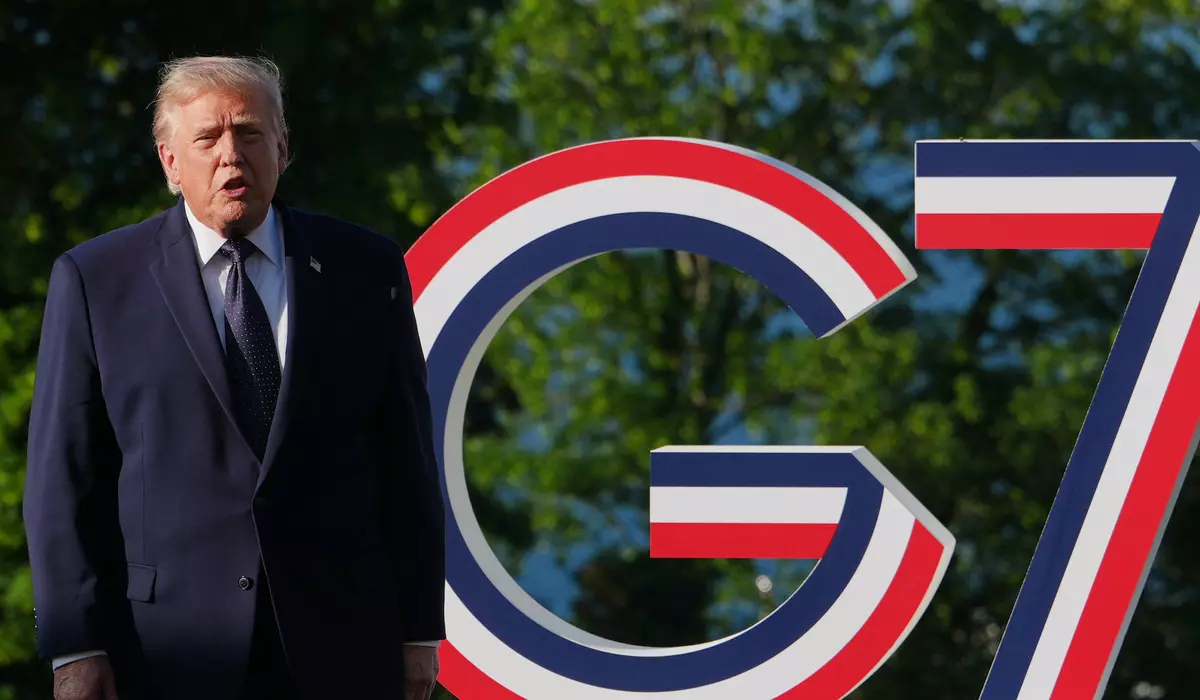
Speaking at the Group of Seven meetings in France, Mr. Trump said he signed the memorandum of understanding late Sunday to reopen the Strait of Hormuz and set the table for limiting Iran’s nuclear program.
“I think a lot of great things are going to happen in the Middle East right now,” Mr. Trump said during a meeting with French President Emmanuel Macron. “Ships are starting to go out now [in the strait]. On Friday, it will be completely open.”
Delegations from both nations intend to travel to Geneva, Switzerland, on Friday for the agreement’s official signing ceremony. Vice President J.D. Vance, special envoy Steve Witkoff and Mr. Trump’s son-in-law Jared Kushner are expected to lead the U.S. delegation.
The exact terms of the MoU have not been released. But the deal established a firm ceasefire and set a 60-day timeline for negotiators to deal with more complex issues like Iran’s nuclear program and its existing stockpile of highly enriched uranium.
Mr. Trump said he did not expect the text of the agreement to be released publicly until Friday or later.
SEE ALSO: Trump predicts ‘great things’ for Middle East, markets after memo signing with Iran
Mr. Trump and Mr. Vance electronically signed the agreement on Sunday, while Iran’s Parliamentary Speaker Mohammad-Bagher Ghlaibaf signed for Tehran, according to senior administration officials.
The Strait of Hormuz would also be reopened to commercial ships under the terms of the MoU, according to the U.S. and Pakistan, though officials have offered differing timelines for when the waterway will be fully open.
Mr. Trump said the waterway would be opened immediately on Sunday, but on Monday he said it would be open by Friday.
Iran has kept the strait closed since early March, sending oil and domestic gas prices skyward.
The deal is also expected to remove the U.S. naval blockade of Iranian ports, which was imposed in early April in retaliation for Iran’s moves in the strait.
Senior administration officials cautioned that it would take some time for maritime traffic to return to normal in the strait. There might be lingering mines in the strait, and ship crews want to see more stability in the region.
SEE ALSO: Iran: Lebanon’s sovereignty is a necessary part of the peace deal
Global markets responded positively to news of a renewed ceasefire agreement between the U.S. and Iran on Monday. Japan’s Nikkei 225 jumped by more than 5.5% in morning trading and South Korea’s Kospi traded just above at 5.7%.
In the U.S., the S&P 500 jumped just under 2% and the Dow Jones Industrial Average was up 719 points as of Monday afternoon.
Brent crude futures fell by approximately 4.2% to $83.68 a barrel during early trading Monday, while West Texas Intermediate dropped to just under $81 a barrel.
The average U.S. price of a gallon of gas stood at $4.07 on Monday, down from $4.53 a month ago but up 37% from when the war started, according to the AAA motor club.
Read more Congress should make E-Verify Trump’s lasting immigration legacy
While the U.S. and others expressed optimism that the deal would hold, serious questions remain about what Iran is willing to give up at the negotiating table and how much it could receive in sanctions relief.
Mr. Vance said that sanctions relief and economic benefits for Iran could only be gained if Tehran displays an ability to make concessions on its nuclear program.
“If you’re willing to give up that program, long-term … then we want you to be a prosperous country,” Mr. Vance told the “Squawk Box” program.
Iran, by contrast, said Monday that the conditions of the deal included the release of billions of dollars worth of frozen assets and compensation for war damages. He also said Washington would be required to lift all primary and secondary sanctions as well as remove “United Nations Security Council and related nuclear measures.”
Critics of the deal have argued that Mr. Trump exited the war too soon and that any agreement that provides sanctions relief in exchange for enrichment limits could not be much better than the Obama-era Joint Comprehensive Plan of Action.
“The chief thing Trump has accomplished is by comparison making Neville Chamberlain look like Winston Churchill. Trump has, quite literally, written a book on the art of a deal, but has allowed Iran to snatch victory from the jaws of defeat,” said Michael Rubin, a senior fellow at the American Enterprise Institute.
Iran’s nuclear program also remains a major sticking point. The U.S. entered the war with Iran in February, declaring that Iran could never obtain a nuclear weapon. Since then, officials have demanded that Iran abandon its enrichment program and give up its stockpile of highly enriched uranium.
Iran, for its part, has repeatedly said it has the right to enrich uranium under international law and that it is not seeking a nuclear weapon.
In addition to sanctions, Israel’s continued assault on Hezbollah in Lebanon could undermine the ceasefire and the subsequent negotiations.
Israeli Prime Minister Benjamin Netanyahu on Monday confirmed that his country’s military would not withdraw from “security zones” already captured in southern Lebanon and would stay for an unspecified duration.
The U.S.-Iran deal reportedly includes the “termination of military operations on all fronts, including in Lebanon.”
Israeli Defense Minister Israel Katz had said as much earlier in the day, insisting that the Israeli Defense Forces would stay in Lebanon “despite all existing pressures and those that may still come.”
Iran has repeatedly insisted that a full ceasefire and withdrawal of Israeli troops in Lebanon is a precondition to any comprehensive deal with the U.S. After Israel launched attacks on Beirut suburbs last week, Iran quickly launched retaliatory measures.
While Washington has brokered peace talks between Lebanon and Israel, Beirut does not control the Iran-backed Hezbollah and the group’s leadership has vowed not to respect the terms of a deal it did not play a part in crafting.
Esmaeil Baghaei, spokesperson for Iran’s foreign ministry, on Monday reiterated Iran’s demand that the ceasefire in Lebanon be enforced.
“The language is completely clear about what any understanding in this regard should entail,” Baghaei said, adding that the agreement includes protections for Lebanon’s “sovereignty and territorial integrity.”
About the Author