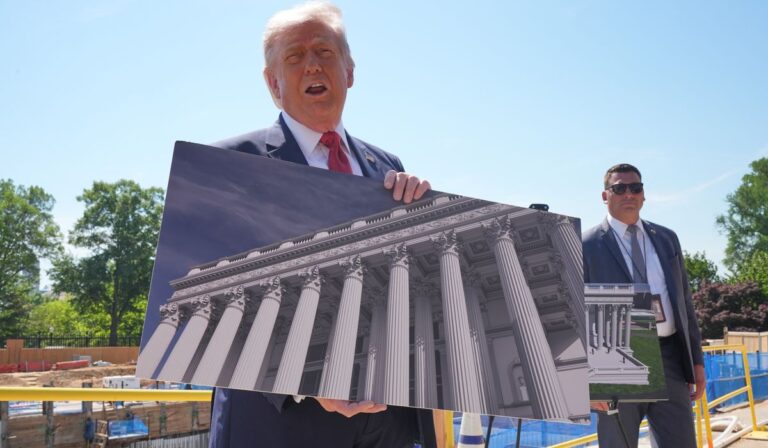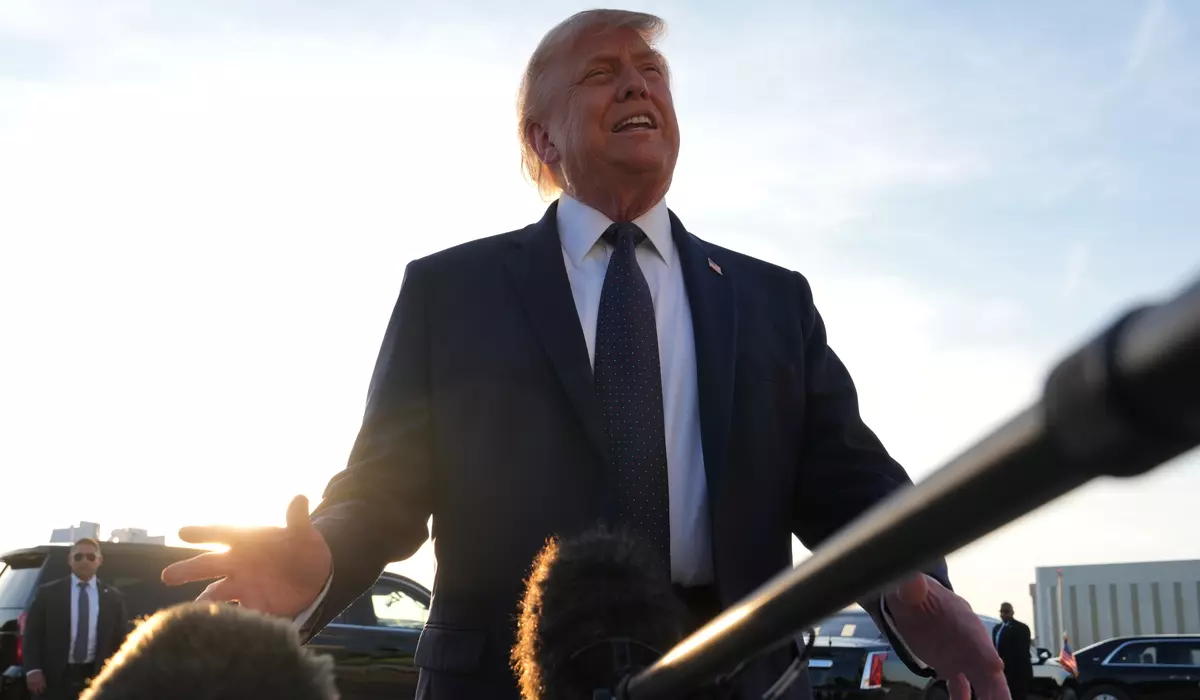
President Trump delivered a vocal sales pitch Wednesday for the peace pact between Iran and the U.S., saying the first-stage deal will forestall Tehran’s nuclear ambitions and avoid the “economic catastrophe” that would have unfolded if bombs kept falling.
Read more Democrats’ ‘election reform’ deserves public scrutiny
Mr. Trump rattled off potential benefits as the world got its first glimpse at the text of a memorandum of understanding that ends hostilities in the Middle East and gives both sides 60 days to make a final deal on nuclear matters.
The president said he achieved “everything, and much more” in the first-stage deal, pushing back on critics who said the U.S. conceded too much and is too trusting of Iran’s regime.
Mr. Trump said Iran won’t receive any economic benefits unless it meets its obligations and that any violations would spark a severe response.
“We’re going to bomb the hell out of them if they violate the agreement,” Mr. Trump said at a press conference to conclude the Group of Seven summit in France. “I don’t want them to. I want them to honor the agreement.”
The administration announced the deal last weekend after months of fighting in the Middle East, with a signing planned for Friday in Switzerland.
The White House has not released the written memo but dictated a version to reporters, including a provision that includes a new “minimum” standard for the downblending of highly enriched Iranian uranium.
The memorandum says the U.S. and Iran would end the war “on all fronts,” including Lebanon. It offers economic benefits for Tehran, including the release of frozen funds and waivers to export oil.
Mr. Trump said no U.S. funds would be used to rebuild Iran. Rather, the deal calls on the American side and partners to create a financing mechanism for reconstruction.
“The United States of America undertakes with regional partners to develop a definitive, mutually agreed plan with at least $300 billion for the reconstruction and economic development of the Islamic Republic of Iran,” it says.
Mr. Trump reiterated that U.S. taxpayers would not give “10 cents” to Iran. He said individuals will be allowed to invest money in the country.
“People can decide to do that, that’s up to them,” the president said.
The memo says the U.S. will lift sanctions on Iran under a yet-to-be-determined timeline, while Iran “reaffirms that it shall not procure or develop nuclear weapons.”
A final deal on nuclear capabilities and uranium enrichment is to be negotiated in the 60 days following the first-stage signing in Switzerland.
Preventing Iran from getting a nuclear weapon is the primary objective of the U.S.-Israel military campaign against Iran, which began Feb. 28 and killed top Iranian leaders while decimating its military infrastructure.
Iran retaliated by closing the Strait of Hormuz, disrupting oil markets and causing higher energy prices.
The pending deal requires the U.S. to lift a naval blockade of Iranian ports within 30 days.
Iran has the same amount of time to ensure regular traffic in the strait, pending the removal of mines.
The deal says Iran can sell oil, specifically that the U.S. Treasury Department will “issue waivers for the export of Iranian crude oil, petroleum products and derivatives, and all associated services, including banking transactions, insurances, transportation, etc.”
Mr. Trump said he was impressed by the Iranian leaders who negotiated the deal.
“Actually, I think they’re smart. I think they’re very smart. I think they’re far less radicalized,” he said. “I think they’re going to behave much differently.”
Mr. Trump pointed to rising stocks on Wall Street in the wake of the tentative peace settlement. Also, consumers are seeing relief at the gas pump.
The national average for a gallon of gas has been falling for three straight weeks and stood at $4.03, down from about $4.50 a month ago but up from around $3 when the war started, according to AAA.
Mr. Trump said a continuing war would have led to economic shocks, and he did not want to be the next Herbert Hoover, referring to the president who oversaw the start of the Great Depression.
Mr. Trump also explained why the deal does not fully constrain Iran from having ballistic missiles.
Read more Gas prices fall in anticipation of U.S.-Iran deal
“What am I going to do? Am I going to let Saudi Arabia have missiles but they can’t have them?” he said.
On Lebanon, the deal calls on the U.S. and Iran to ensure “the territorial integrity and sovereignty” of the country.
Mr. Trump said Israel can defend itself from Iran-backed Hezbollah terrorists in Lebanon, though he added the Israelis should be wise about targeting the terrorist group.
“I want Israel to be able to protect itself,” Mr. Trump said. “But I do want them to use good judgment.”
The president warned that the deal text may not be final. If he is not happy with the final text, fighting would resume.
“If I don’t like it, if they don’t behave, we’ll go right back to dropping bombs right smack in the middle of their head because they misbehaved for 47 years,” he said.
Among critics, former Vice President Mike Pence said the deal seemed to appease Iran with upfront concessions.
“I mean, to throw a lifeline to the Iranian regime when they are weaker and more isolated than they have ever been in history, I think would be a historic error,” he told CNN.
White House officials say the deal is performance-based, so Iran won’t get benefits unless it lives up to its commitments.
They say it offers Iran a unique opportunity to open itself to the world and bring greater harmony in the Middle East.
“They will never have a nuclear weapon,” Mr. Trump said at the G7. “It’s a very strong deal.”
Sen. Lindsey Graham, a South Carolina Republican and national security hawk, said he remained hopeful.
“Whether or not the United States can reach an acceptable, verifiable deal with Iran regarding its nuclear program and other issues is yet to be determined, but I see little downside to trying,” he wrote on X. “The economic stability that comes from opening up the Strait and the cessation of hostilities could create a pathway to peace well beyond the Iranian conflict.”
Democrats, meanwhile, faulted Mr. Trump for keeping Congress in the dark about the fine print.
“Trump must brief Congress, release the official text of the ’understanding,’ disclose any secret side deals to the public immediately, and end this war now,” Senate Minority Leader Charles E. Schumer, New York Democrat, said on X.
NATO Secretary-General Mark Rutte on Wednesday praised Mr. Trump’s tentative agreement.
“The U.S. action to prevent the threat of a nuclear-armed Iran and degrade its ballistic missile capability improves security for us all,” Mr. Rutte said at a press conference at NATO headquarters in Brussels. “The deal President Trump struck has created an opportunity to ensure Iran never obtains a nuclear weapon.”
Mr. Rutte said the expected restoration of vessel traffic through the Strait of Hormuz would be a “massive step forward.”
Mr. Trump said he might stick around in Europe to attend the deal-signing. He also said the memorandum was not the type of document that presidents usually sign personally.
Vice President J.D. Vance is expected to be on hand for the signing, leading Mr. Trump to joke: “This way, if it works out, I’m going to take the credit.”
“If it doesn’t work out, I’m blaming J.D.,” he said. “You better be careful, J.D.”
Read more Federal Reserve keeps rates steady, despite Trump’s new chairman
• Mike Glenn and Mary McCue Bell contributed to this story.
About the Author