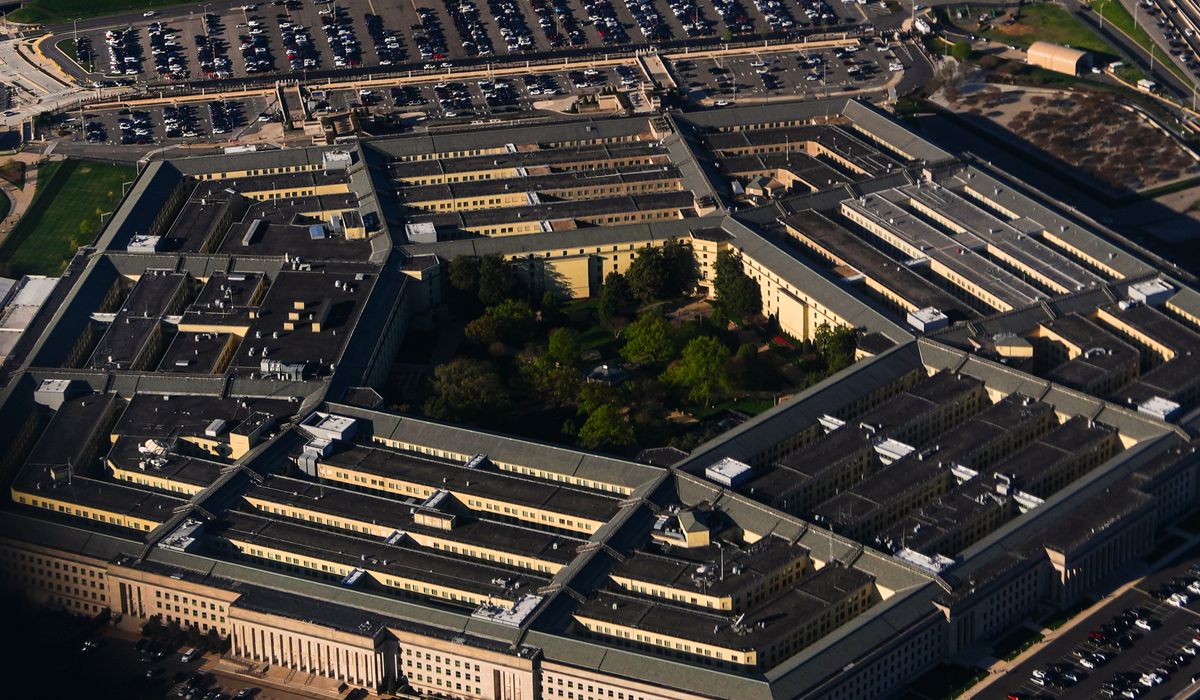
President Trump has invoked the Cold War-era Defense Production Act to spur the production of more munitions, stockpiles of which have dwindled amid the U.S. war against Iran and years of heavy American military aid to allies such as Ukraine and Israel.
Read more U.S. gas prices fall below $4 for 1st time since March, but still 25% higher than last year
In a addressed to Defense Secretary Pete Hegseth, made public this week, Mr. Trump said it was necessary to invoke the 1950 law.
“I hereby find that conditions exist which may pose a direct threat to the national defense or its preparedness programs,” . “In particular, systemic constraints in the munitions industrial base, including limited production capacity, fragile supply chains, long-lead dependencies, and related production bottlenecks, may impair the ability of the United States to produce, sustain, and expand the availability of munitions, missiles, and equipment required for the national defense.”
Mr. Trump specifically cited sections of the law that provide for the “making of voluntary agreements” to “provide for the national defense.”
Key Trump administration officials described the move as a way to bring defense companies together to accomplish a specific goal — such as the rapid production of missiles and their key components — in a way that could otherwise violate federal antitrust provisions.
“It’s a way for us to communicate and leverage industry using a specific set of authorities,” Michael Cadenazzi, the Pentagon’s assistant secretary of war for industrial base policy, said earlier this week.
“In this particular case, our interest is using voluntary agreements as a way to bring industry in, in an anti-trust environment, to go ahead and have conversations with them to articulate problems to them around nasty issues in the supply chain or industrial base,” he said at a June 16 event hosted by the Center for a New American Security, a leading Washington think tank. “We’re asking them to work together in a way that would normally be problematic in an open and competitive market sense. Sometimes we need the collective wisdom of all the assembled companies” in America’s defense industrial base.
The Defense Production Act has been invoked many times. Mr. Trump used it several times during his first term in office, including during the COVID-19 pandemic, when it was invoked to accelerate the production of ventilators and other crucial pieces of medical and public-health equipment. Former President Bill Clinton, for example, invoked the act to secure gas and electricity production during a shortage in California, according to a fact sheet from the International Energy Agency.
Read more Israel says its troops will stay in southern Lebanon, directly contradicting U.S.-Iran agreement
But the current situation is unique. Mr. Trump’s use of the law comes at a moment of serious concern on Capitol Hill and in defense and national security circles that U.S. supplies of critical munitions are far too low. The fear is that in a worst-case scenario, the U.S. military may run short on key munitions in a clash with China.
It’s unclear exactly how the “voluntary” assembly of leading U.S. defense companies will play out in the coming weeks and months. But it’s another example of how the Trump administration is aggressively using its federal authority and funding to accomplish specific goals in the defense industry.
Earlier this year, the Pentagon announced it would invest $1 billion in a new company, spun off from defense industry giant L3Harris, that will produce solid rocket motors. Solid rocket motors are key components of advanced missile systems. America’s stockpile of those systems has been dramatically reduced because of U.S. arms transfers to Ukraine, Israel and other allies. It’s been further strained by the conflict with Iran.
Just this week, the Pentagon announced more than $1 billion in conditional loans to U.S. companies that process rare-earth elements. Those 17 elements are crucial for producing advanced electronics and fighter jets, among many other things. China has dominated the world in processing those elements.
SEE ALSO: Investment in defense tech is soaring as Pentagon encourages venture capitalists to participate
Specifically, is likely intended to spark the production of more precision strike missiles, Patriot missile interceptors, Terminal High Altitude Area Defense, or THAAD, missile interceptors, and other capabilities used extensively by the U.S. and its allies during the Iran war.
Read more Chinese AI poses serious and growing threat to U.S. national security, report reveals
About the Author