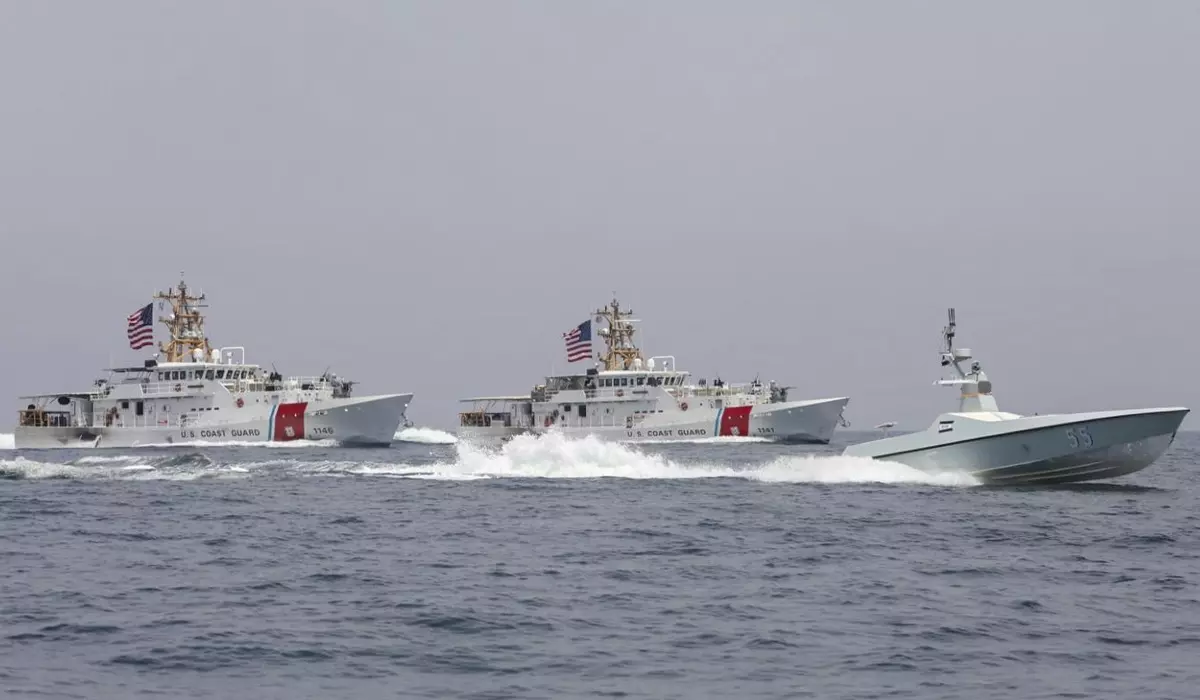
The U.S. Navy and its defense industry partners are moving beyond the prototyping phase and toward production of cutting-edge drone boats, a key Pentagon official said this week, with expected increases in defense budgets set to help fund a revolution in unmanned maritime technology.
Read more Carville calls for House Democrats to reject socialist candidate
Rebecca J. Gassler, the Navy’s portfolio acquisition executive for robotic and autonomous systems, told an audience in Washington on Wednesday that the Navy specifically needs medium unmanned surface vessels, generally defined as vessels between about 40 and 170 feet long.
“The time is now,” Ms. Gassler said during a panel discussion on autonomy at this week’s “IndoPac 2026 | Naval Dominance: Shipbuilding, Autonomy & C2,” a major forum hosted by The Washington Times’ Threat Status national security team and held at the U.S. Navy Memorial in downtown Washington.
“The money is there. The investors are there. They have put their own money into building this class of boats,” she said. “The fleet has expressed a need and a want to have these ships. And we’re building toward a specific mission right now.”
In her role, Ms. Gassler is tasked with unifying and accelerating robotics and autonomous systems across the Navy.
In the Trump administration’s proposed fiscal 2027 budget, the funding for sea drones and other uncrewed maritime assets is rising fast. The Pentagon is seeking $54.6 billion for its Defense Autonomous Warfare Group, the umbrella initiative that oversees the effort to produce and field drones in huge numbers.
The 2027 budget request includes major funding increases for aerial and ground drones, but the largest percentage increases would go to the MUSVs mentioned by Ms. Gassler, along with other unmanned systems, such as the Navy’s torpedo tube-launched and recovered remotely operated vehicle.
Those two initiatives would see funding increases of 584% and 183%, reaching $270 million and $76 million, respectively, according to data provided exclusively to Threat Status by Obviant, an AI-driven data intelligence company based in Virginia and the official data partner of the IndoPac event.
Read more NYPD braces for a Swifties invasion for the wedding of Taylor Swift and Travis Kelce
The Navy intends to deploy more than 30 medium USVs, along with thousands of smaller USVs, in the Indo-Pacific by 2030.
But there are questions about whether the U.S. defense industrial base can move fast enough to build them on time and under budget.
“Can all of that money actually be absorbed into the [defense industrial base] effectively and efficiently? I don’t know that the answer is yes,” Rep. Pat Harrigan, North Carolina Republican, said at the forum.
Uncrewed sea drones will carry out a host of missions, from potential combat operations to equipment delivery and rescues.
Late last month, the Navy announced it selected seven companies to take part in the at-sea testing phase of the MUSV marketplace. Companies that successfully complete at-sea testing will get $15 million and be eligible for follow-on production, which is the transition from a prototype project to manufacturing and fielding, the Navy said.
Those seven companies are: Sea Machines, Leidos, Saronic Technologies, Galliano Marine Services, PacMar Technologies, Birdon and Huntington Ingalls Industries.
Read more Left-pressured Newsom calls for ‘national billionaires tax’
At-sea testing is expected to be completed by October, Navy officials said.
About the Author