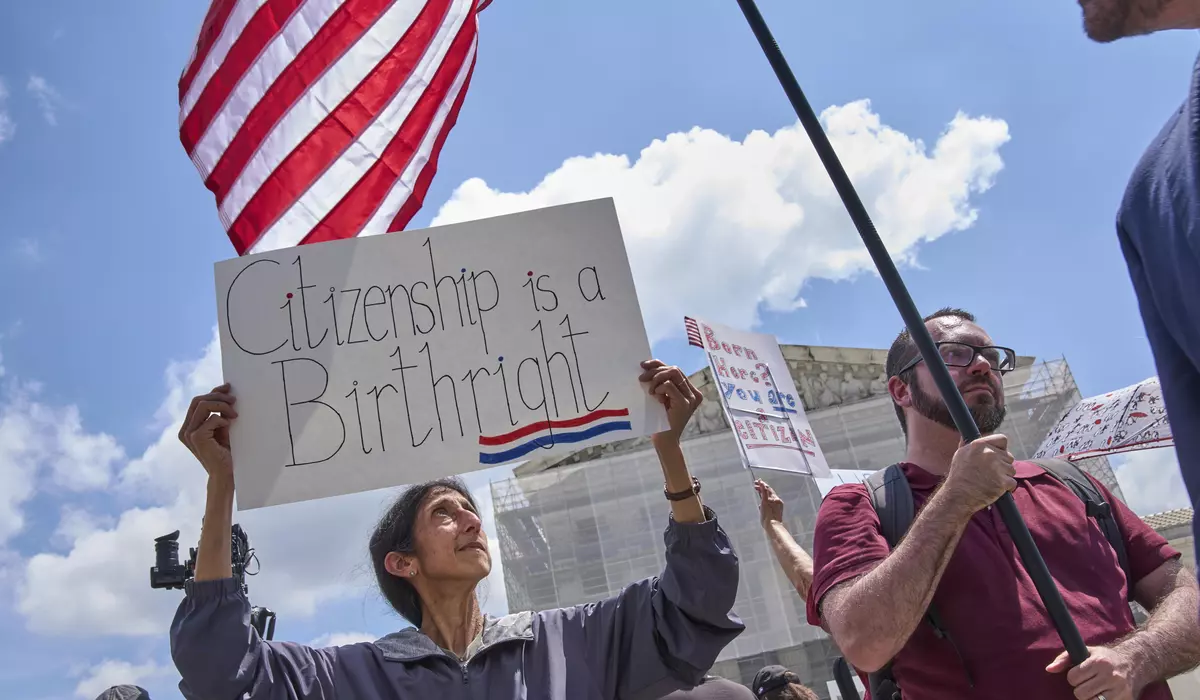
The Supreme Court forcefully affirmed America’s guarantee of automatic citizenship to persons born on U.S. soil, ruling Tuesday against President Trump’s attempt to unilaterally rewrite the bedrock birthright.
Read more Supreme Court rules states can bar transgender athletes from girls’ sports
The court’s majority said the Constitution was clear when it granted citizenship to “all persons born or naturalized in the United States, and subject to the jurisdiction thereof” — and that includes children of illegal immigrants or temporary legal visitors.
“Citizenship, then and now, was the right to have rights — to freely participate in our political community. The Framers of the Fourteenth Amendment extended that promise to ’every free-born person in this land,’” Chief Justice John G Roberts Jr. wrote for the majority. “We keep that promise today.”
Mr. Trump’s executive order had attempted to deny citizenship to children born in cases where both parents lacked permanent legal status. That included illegal immigrant parents and those here on visitor visas, such as foreign students, guest workers and tourists.
Justice Clarence Thomas led the dissent, saying his colleagues were over-reading the 14th Amendment, enacted in the wake of the Civil War to guarantee citizenship to freed Black slaves.
“The court today takes the extraordinary step of holding facially unconstitutional the president’s order excluding from citizenship the children of foreign temporary visitors and illegal aliens. In doing so, the court adds to the sad history of the Fourteenth Amendment, which was designed and understood to secure equal rights for the freed blacks but has instead been repurposed for political projects that the Reconstruction Congress did not support,” he wrote.
America’s guarantee of birthright citizenship is common for most of the Western Hemisphere, including Brazil, Mexico and Canada.
Read more Hegseth names Defense Policy Board members after dismissing previous advisory group
But it is a relative rarity for America’s peer nations elsewhere, according to a 2018 survey by the Library of Congress. Spain, Great Britain and Germany based citizenship on a parent’s status, while France based it on age and residency of the child. Australia used a combination.
Ireland had unconditional birthright citizenship until 2005, when it imposed restrictions based on a parent’s status.
Some countries also don’t recognize children born to parents who aren’t on their own soil. That would create a tricky problem if those children are born in the U.S., because they could be considered stateless persons.
Mr. Trump’s executive order couldn’t change the language of the Constitution. Instead it directed the federal apparatus not to recognize children born to those parents the president had singled out.
The Trump administration has pointed to “birth tourism” as a troubling aspect of allotting birthright citizenship to legal temporary visitors. That’s the practice of foreign women traveling to the U.S. just to give birth, then returning home with their children, who grow unattached to America.
Chinese firms offer birth tourism packages, charging tens of thousands of dollars to arrange travel, help obtain Medicaid coverage for the women so taxpayers foot the bill, and coach families on how to get through interviews with U.S. border authorities.
Read more Trump expected to exit USMCA trade pact with Canada, Mexico
About the Author