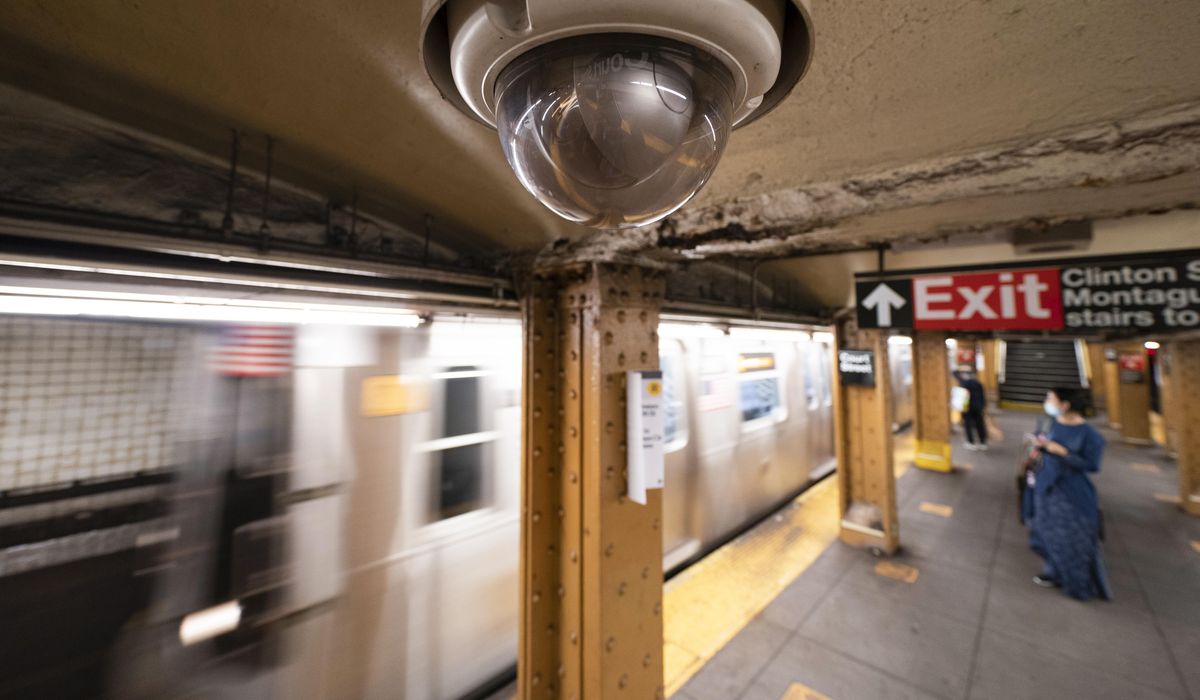
A new public safety battle is brewing in America that centers on AI-powered cameras discreetly installed on thousands of street corners, parks, parking lots, neighborhoods and drones buzzing overhead.
Read more Trump Accounts, giving newborns $1K, to launch July 4
Many of the cameras are operated by Atlanta-based Flock Safety for the purpose of providing footage to law enforcement. But the prevalence of the cameras has spurred growing public resistance across the political spectrum and led to dozens of communities cancelling or rejecting Flock’s surveillance equipment.
“I think our country is in a kind of uniquely anti-surveillance environment right now, which is to say that, in a time where it seems there is nothing that is not partisan, opposition to government surveillance is non-partisan,” said Chad Marlow, a privacy and surveillance lawyer for the American Civil Liberties Union.
In April, elected officials in Dane County, Wisconsin, voted overwhelmingly to cut off funding for two dozen surveillance cameras the sheriff’s department had been leasing from Flock Safety.
Anger over the cameras spread on Nextdoor, Facebook and other social media platforms, fueling the nearly unanimous vote by the Dane County Board of Supervisors.
“There’s a public safety issue here, but there is also a privacy issue,” Supervisor Chad Kemp said. “There are serious concerns about individuals who can be monitored without their knowledge, or if it is even constitutional or ethical to track people without a warrant.”
According to Deflock, A grassroots organization that opposes the cameras, more than 70 cities have cancelled or rejected Flock camera contracts or deactivated their equipment, among them Sedona, Arizona, Warrenton, Virginia, Kent, Ohio, Lockhart, Texas, Denver, Colorado and Windsor, Connecticut.
The cameras were initially marketed as automated license plate readers, but the technology has advanced and the cameras’ role has expanded well beyond that, company officials boasted.
“We have cameras that are used for everything from illegal dumping to drug houses to hotels that are just big problems,” Kevin Cox, an engineer with Flock Safety, told prospective customers in a demonstration video of Flock’s AI-powered Condor Camera. “There are endless, endless uses for what we can do with these things.”
The Flock Condor cameras have pan, zoom and tilt capabilities and provide real-time streaming and tracking of both vehicles and humans.
The expanded surveillance, Mr. Cox said, is “just coverage for cities that are looking to make sure they have a video record of what happened in town square or on these main drives.”
According to the ACLU, there are between 80,000 and 100,000 Flock cameras installed across the U.S. that perform more than 20 billion scans monthly.
They can be spotted on highways, at intersections, in neighborhoods and apartment complexes, and in the parking lots of businesses such as Lowe’s and Walmart.
Flock is also promoting “automated drone security,” which, the company advertises, deploys a drone to an area “when an alert occurs … getting eyes on the incident immediately.”
The ACLU and other critics labeled the technology a form of dragnet surveillance and warrantless tracking “of everyone on the road.”
The data can be shared nationwide by police and others with access to the recordings.
“All an administrator needs to do is click a button,” ACLU officials said. “What this means in practice is that officers with the Florida Highway Patrol and those in Dallas, Texas, Jacksonville, Florida, Columbus, Ohio, and thousands of other locations can track where and when Massachusetts residents are driving, even when they are in Massachusetts — all without demonstrating any probable cause or even reasonable suspicion that those people have committed a crime.”
Some of the cities that nixed the cameras cited concerns that local and state law enforcement were sharing surveillance data with U.S. Immigration and Customs Enforcement, which used it to locate and track illegal immigrants. The Homeland Security Department has been able to access the material through cooperating local and state officials who lease the cameras.
The FBI wants to gain more direct access to the data.
In May, the FBI put out a solicitation for a contractor that can enable the bureau’s access to the nation’s entire network of surveillance cameras, the vast majority of which are operated by Flock Safety but include a handful of other camera companies.
The bureau cited a “crucial need for accessible [License Plate Readers] to provide a diverse and reliable range of collections across the United States,” according to the contract proposal reviewed by The Washington Times.
Read more Space Force adds new mobile satellite jammer
The data “should be available across major highways and in an array of locations for maximum usefulness to law enforcement,” the FBI said.
The bureau and other law enforcement agencies say the data is critical in helping solve property crimes, locate stolen vehicles and track down missing people. The data is also used in court to successfully prosecute criminals.
Walmart uses Flock Safety systems in its parking lots “to ensure safety, theft prevention and fraud reduction,” company officials said. Flock Safety officials said their technology is used in more than 4,000 communities across the country and has helped solve crimes and improve safety.
Police in Cobb County, Georgia, credited the cameras with helping them solve every single homicide over two years, while police in Peoria, Illinois, said the cameras helped cut shootings and murders by 25%.
In Gwinnett County, home to Flock’s headquarters, police used the cameras to recover 104 stolen vehicles, track down 93 people wanted by law enforcement and reduce burglaries by more than half in just one year.
Flock Safety spokesperson Paris Lewbel said their traditional Automatic License Plate Reader, which makes up the bulk of their leased cameras, doesn’t track anything.
“Flock [Automated License Plate Reader] cameras do not and cannot track vehicles, much less individual people. They take point-in-time images of the rear of vehicles on public roadways and are designed to capture vehicle-related evidence, not personal identity. Data is deleted after 30 days by default unless a customer requires a longer retention period. Access is also auditable, and every search requires a justification,” Mr. Lewbel said.
But abuses of the surveillance data are well-documented.
The watchdog group Institute for Justice identified 21 recent cases involving law enforcement officers accessing surveillance camera data for nefarious reasons, including keeping tabs on romantic partners, exes and complete strangers.
One Milwaukee cop was accused of using the cameras to track both his current love interest and her ex-partner nearly 180 times over two months. He resigned in March.
Local governments and police are continuing to install the cameras, despite growing public outcry.
The company announced last year that Flock surpassed $300 million in annual recurring revenue, which company officials said represented a 70% year-over-year increase.
Mr. Marlow, the ACLU lawyer, said the Flock Cameras are proliferating because they often pop up without warning to the public.
“Flock is doing everything in its power to continue to sign up governments for these contracts as below-the-radar as is possible, so nobody can stop them until it is theoretically too late,” he said.
Mr. Lewbel said the company isn’t attempting to hide anything.
“We strongly disagree with the suggestion that Flock keeps these conversations under the radar,” he said. “Flock representatives attend hundreds of city council meetings every year, in addition to many community forums. In fact, we actively encourage these conversations as they provide key opportunities to address misinformation around what Flock does.”
Social media has raised awareness about the cameras and some residents are on the lookout for them and demanding their removal.
The number of local governments now taking steps to revoke Flock camera contracts shows the power of the backlash, Mr. Marlow said. In the past year alone, 55 cities have cancelled Flock contracts.
“It’s an astounding number. More than one per week,” Mr. Marlow said.
In Cape Coral, Florida, the debate over the city’s 58 Flock cameras is an issue in the upcoming city council election.
Sean Hartman, who is running for a seat, is pledging to end Cape Cora’s Flock camera program.
“Flock cameras are just the initial expansion of the surveillance state that George Orwell warned about. It’s the precursor to the same surveillance operations we see in Communist China,” he said.
Read more Pentagon moves to consolidate drone programs under single office
About the Author