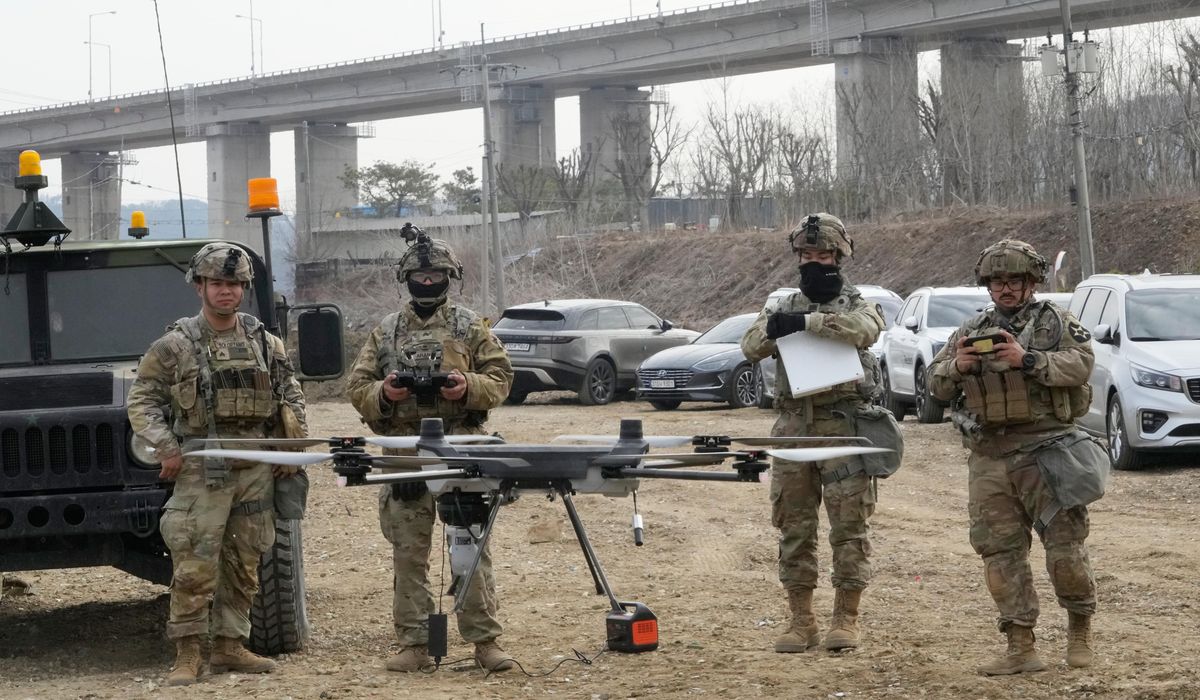
The Pentagon is moving nearly every unmanned and autonomous systems program into a new office, in a bid to catch up in a global production race the U.S. is currently losing by volume.
Read more From refrigerators to rock ‘n’ roll — America marks 250 years of unsung inventions
In a Wednesday announcement, the Pentagon said the new office, called DRPM-UxS, will oversee unmanned systems funding and programs currently spread across four bodies: the military service components, Joint Interagency Task Force 401, the Defense Innovation Unit, and the Defense Autonomous Warfare Group.
“Adversaries collectively produce millions of unmanned systems each year across all domains. While global military production has skyrocketed over the last three years, the United States must move at the speed this moment demands to field these capabilities at scale and secure our tactical and strategic edge,” Pentagon spokesperson Sean Parnell wrote in a statement.
The Pentagon has not yet named anyone to lead DRPM-UxS, but whoever takes the job will report directly to Stephen A. Feinberg, deputy secretary of defense.
U.S. rivals China and Russia are far ahead when it comes to manufacturing cheap and effective drones for use on the battlefield. Ukrainian intelligence figures estimate that Russia plans to manufacture more than 7 million small First Person View, or FPV, drones in 2026, while the Pentagon’s new Drone Dominance program plans to build approximately 340,000 drones over two years.
China produces the vast majority of the world’s commercial drones and has a stranglehold on the production of the components that go into them, including batteries, cameras and airframes.
The office inherits four bodies with historically distinct missions that don’t all line up neatly to scale drone production. Joint Interagency Task Force 401 was built to counter small unmanned drones, not build them, while the Defense Innovation Unit vets private-sector technology for military use across the armed forces, not just unmanned systems.
It remains to be seen whether the Pentagon will require these offices to radically reform under DRPM-UxS’s direction. Earlier this year, Defense Secretary Pete Hegseth reorganized several tech innovation bodies, including the Defense Innovation Unit, placing them under a single chief technology officer directed to move at “wartime speed.”
Read more Judge who allowed illegal immigrant to escape ICE begs for no jail time, says she’s suffered enough
The reorganization implements two executive orders President Trump signed last year: “Unleashing American Drone Dominance” and “Restoring American Airspace Sovereignty.” The first directed the Pentagon to procure and train using low-cost, high-performing drones made in the U.S., while the second expanded detection and tracking capabilities to protect critical infrastructure from unauthorized drone activity.
Mr. Hegseth followed up with a memo last July, committing the department to building up domestic drone manufacturing, arming combat units with low-cost systems, and training troops to use them — the groundwork for Wednesday’s consolidation.
The $1.15 trillion 2027 National Defense Authorization Act, which cleared the Senate Armed Services Committee last month, includes language urging the Pentagon to establish a “Robotic and Autonomous Systems Combatant Command” to improve domestic drone production.
Critics on the Hill and in the security community have said the Pentagon’s drone programs are too scattered, and that a single oversight body could help streamline production.
“The bill responds to the modern battlefield with thoughtful approaches on artificial intelligence, autonomous weapons, low-cost munitions, and cyber operations,” Senate Armed Services Committee Chairman Roger Wicker, Mississippi Republican, said in a statement in June.
Rep. Pat Harrigan, North Carolina Republican, made a similar case Wednesday, tying the reorganization to money already appropriated for the mission. “Our adversaries have been operating this way for years while we argued over turf,” Mr. Harrigan wrote on X. “We are finally getting serious about catching up, and with $54 billion behind autonomous warfare in the FY27 budget, the resources are there to do it.”
Read more China turns Russia’s drone war into a warning for U.S.
About the Author