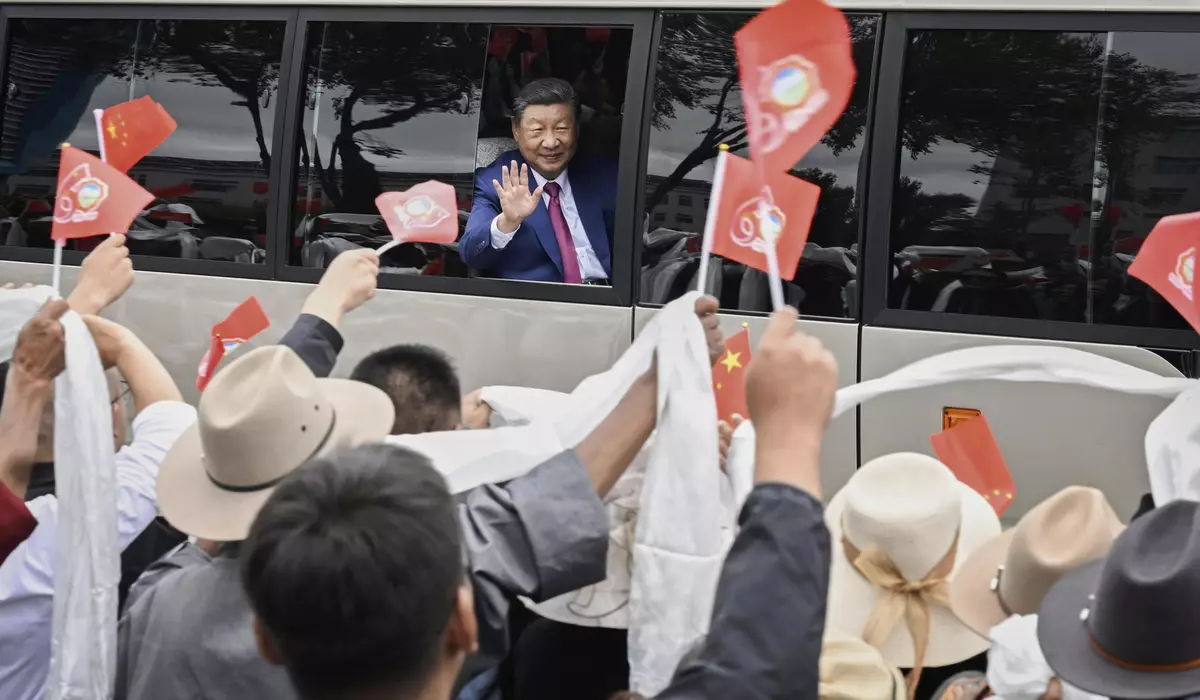
Overseas opposition to China’s new “Ethnic Unity and Progress Promotion Law” took off Thursday after Beijing made the act official a day earlier.
Read more Facing barbs and pressure from Trump, Europe’s leaders close ranks
The act is aimed, according to China, at creating a shared national identity among the country’s 56 ethnic groups. Beijing says the new law will help ensure balanced national development across all regions. But critics say Beijing’s real aim is to accelerate minorities’ assimilation into the dominant Han Chinese culture.
One expert said it reflects historic paranoia about separatism and strife at the heart of the Chinese Communist Party.
On Thursday, concerns about the law’s apparent extraterritorial provisions led to pushback from the European Union, discussions on countermeasures in Taiwan and strong words from the U.S. State Department.
Equality or assimilation?
The law “is designed to enhance cohesion and common prosperity among all 56 ethnic groups,” wrote official state news agency Xinhua. “This comes as the country enters the final decade of its drive to basically achieve modernization by 2035.”
It stipulates “upholding national unity and ethnic solidarity is the responsibility of all Chinese citizens, and prohibits discrimination and suppression against any ethnic group,” Xinhua continued.
Critics differ.
“Chinese authorities have human rights obligations requiring them to protect minority communities and their cultures, but this law does the opposite,” said Sarah Brooks, regional director of global human rights group Amnesty International. “Rather than celebrating difference, it is about pushing ethnic groups such as Uyghurs, Tibetans, and Mongolians to adopt a single, state-defined national identity dominated by Han Chinese culture.”
A bipartisan group of 14 U.S. members of Congress went further.
Writing to the State Department on Tuesday, the group called the law ” … a tool of forced assimilation, ideological control and transnational repression” in a message posted on the site of Rep. Jim McGovern, Massachusetts Democrat.
China, the world’s second most populous nation after India, is majority Han Chinese. 2020 census data found 125 million members of 55 ethnic minorities — including Hui, Koreans, Manchus, Mongolians, Tibetans, Uighars and Zhuang — making up just under 9% of the total population.
Chinese media reported that in recent years, ethnic minority areas have experienced slightly faster economic growth rates than the national average. However, the only minority that is, per capita, more prosperous than Han Chinese, are Korean-Chinese.
Many minorities appear comfortably assimilated.
Others, notably Tibetans and Muslim Uighars, have been restive, with expatriate communities and activists saying that compatriots in China are suffering cultural eradication and state injustices.
The law “codifies forced assimilation policies, including colonial-style boarding schools in Tibet,” said Dorjee Tseten, a U.S.-based Tibetan activist and former member of the Tibetan Parliament-in-exile. “Rather than promoting unity, it criminalizes efforts to protect the Tibetan language, culture and identity with the aim of erasing the distinct national identity of the Tibetan people.”
Pro-Chinese voices say compulsory Mandarin education offers ethnic minorities the tools necessary to advance in China’s educational, bureaucratic and business sectors, where Mandarin is the lingua franca.
According to activists, state boarding schools established for Tibetan children, some as young as four, teach a Beijing-centric curriculum, with minimal classes in Tibetan, causing inter-generational communication barriers between children and their parents, and dilution of ethnic identity.
Separatism on the frontiers
Xinjiang, home of the Uighars in China’s northwest, was taken over by the Peoples Liberation Army in 1949. Tibet, home of the Tibetans in China’s west, was conquered by the People’s Liberation Army in 1950 and annexed — “liberated” in Beijing terminology — in 1951.
A Tibetan uprising, aided by the CIA, was crushed in 1959. An exile community, headed today by spiritual leader the Dalai Lama, is based in Dharamshala, India.
Since then, Beijing has established the Tibetan Autonomous Region for local governance, undertaken land redistribution and overseen the movement of Han Chinese into Tibet, where they reportedly make up around 12% of the populace.
During the global war on terror, up to 5,000 Chinese Uighar, according to some estimates, joined Islamist fighters in the Middle East — mostly in Syria, but also in Afghanistan and Iraq.
Read more Ethics Committee says it doesn’t have sexual harassment settlement data that House resolution seeks
Some were dubbed terrorist groups by Washington, though that classification was dropped in 2020.
More recently, some have reportedly been incorporated into the Syrian Armed Forces.
The appearance of militants, together with deadly riots and knife attacks, allegedly by Uighar separatists, on Han Chinese between 2009 and 2014, ignited security fears in Beijing.
Leaders responded with crackdowns across Xinjiang, buttressed by the establishment of a high-tech security net. By 2017, as many as 1.8 million Uighars were incarcerated in facilities which China called re-education camps, and which critics called concentration camps, complete with forced labor.
The law went into effect this week “represents a legitimate sovereign measure to protect Chinese people from disruption by separatist forces,” Xinhua stated.
It aims to combat “violent terrorism, ethnic separatism and religious extremism, holding organizers, planners, perpetrators, instigators and funders of these activities criminally liable.”
Geoff Cain, author of 2021’s “The Perfect Police State,” a book on China’s extensive security oversight technologies, says fear of separatism and chaos is baked into the Chinese Communist Party’s DNA.
“The CCP, by its very foundation, is a paranoid government born of civil war, of strife, and of having to fight among many scattered ethnic groups,” the author said.
Subsequently, further paranoia “stemmed from watching the dissolution of the Soviet Union,” he said, referencing violent conflicts that broke out in frontier republics like Chechnya and Georgia — possibly analogous to Beijing’s fears of separatism in Tibet and Xinjiang.
“The current law is a major leap as the CCP under Xi Jinping tightens its grip,” he said.
Overseas application?
Amnesty fears the law could be deployed abroad. During a June 24 State Council press conference, officials confirmed that authorities consider aspects of the law applicable beyond China’s borders, the NGO said.
Amnesty’s concerns were amplified by foreign governments Thursday.
According to Reuters, a U.S. State Department spokesperson said the law required Chinese nationals overseas to “actively promote the Chinese Communist Party’s ’ethnic unity’ agenda or face retaliation from Chinese authorities.”
The spokesperson added, “The United States will safeguard our sovereignty and defend individuals from the overreach of foreign governments and regimes trying to silence, intimidate harass, harm or coerce them within our border.”
Taiwan’s Mainland Affairs Council said on Thursday that the law was a tool for “forced unification” and inter-ministerial discussions on countermeasures were underway, Radio Taiwan International reported.
Taipei will “strengthen public awareness, civil servant training, administrative reviews, assistance and protection mechanisms,” the MAC said, and would also reach out to fellow democracies to oppose “transnational repression.”
Also Thursday, the European Union spokesperson said, “We are concerned about the extraterritorial application of the law,” Reuters reported from Brussels. “The EU opposes the extraterritorial application of third-country legislation in breach of international law.”
Read more AOC jumps into Michigan Senate fight, backing El-Sayed over party establishment
About the Author