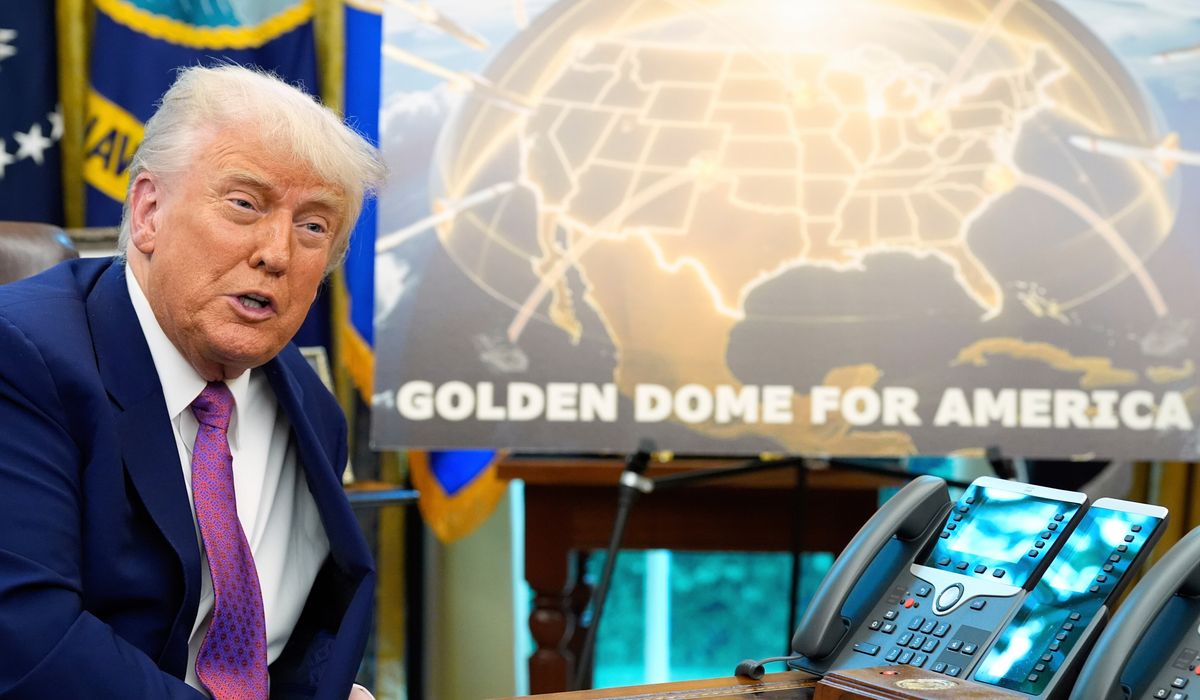
The Trump administration’s Golden Dome missile defense shield project is expanding its secretive network of space-based, missile-detecting satellites with a $1.75 billion dual contract for two defense technology firms, despite concerns on Capitol Hill about ballooning costs.
Read more Trump walks back planned tolls in Strait of Hormuz, moves to reinstate blockade of Iran’s ports
The Space Development Agency, an arm of the U.S. Space Force, has announced that roughly $955 million will go to Florida-based L3Harris Technologies for the production of “18 Hypersonic and Ballistic Tracking Space Sensor (HBTSS)” satellites.
The other roughly $798 million will go to Colorado-based Sierra Space “to provide 18 missile warning/missile tracking variant [space vehicles] across two orbital planes,” the agency said in a press release on Monday.
The announcement comes amid concerns among some U.S. lawmakers over drastically varying long-term cost estimates for creating Golden Dome, a signature defense initiative of President Trump, who has vowed to deliver the system to counter growing missile threats from such adversaries as China, Russia and North Korea.
Golden Dome has received substantial support from Republicans in Congress, but several Democrats have pushed back against the system and potential cost overflows are cited as a major concern.
Analysts have continued to request more information about the secretive missile defense system. The Pentagon last year issued a gag order forbidding U.S. military officials from discussing the technical specifics of Golden Dome’s architecture.
Gen. Michael A. Guetlein, vice chief of space operations at the U.S. Space Force and the man widely known as Mr. Trump’s “Golden Dome czar,” revealed late last year that he had held “one-vs.-one” talks with more than 300 private companies to hash out the secretive architecture.
He told an audience in December that although the layered design of the Golden Dome remained classified, he was confident “our industry partners have a pretty good insight into what we’re doing,” and that the president wanted the system operational over the entire U.S. homeland by mid-2028.
Congress approved $24.5 billion in Golden Dome funding for 2025 and another $13.4 billion for this year.
Democrats on the Senate Armed Services Committee have described the funding as a “slush fund.”
The Congressional Budget Office (CBO) has estimated the total cost will be greater than $1 trillion, even as estimates out of the Pentagon sit below $200 billion.
The CBO has also predicted that nearly 8,000 space-based interceptors in low-Earth orbit will be needed to defend against just 10 incoming missiles. The office has warned that a major ballistic and hypersonic missile attack by adversaries could overwhelm Golden Dome.
Gen. Guetlein has downplayed such concerns. “They’re not estimating what we’re building,” he said at an event in May.
The U.S. Space Force has said it will leverage at least 12 defense contractors to produce the Golden Dome.
Read more Foreign ships, American fury: Trump’s gamble on foreign oil tankers nears a deadline
The HBTSS satellites referenced in Monday’s Space Development Agency press release are seen by some defense industry insiders as an essential piece of the overall system.
President Trump’s January 2025 executive order for the system called explicitly for the “acceleration of the deployment” of an HBTSS satellite layer as part of the missile defense shield.
L3Harris Technologies had been working with the Space Development and Missile Defense agencies on launching HBTSS satellites prior to Mr. Trump’s executive order.
Ed Zoiss, the vice president of engineering, technology and innovation at L3Harris, said in an interview on The Washington Times’ Threat Status Influencers program last year that the HBTSS system tracks missiles using infrared technology, which can be tricky with futuristic hypersonic glide missiles, whose speeds change in more complex ways than conventional intercontinental ballistic missiles.
“The goal of this satellite is to find [the] dim heat signature for that hypersonic weapon and then to track it,” he said, adding that L3Harris had successfully demonstrated that “it can be done from space.”
Other industry insiders say space-based interceptors and tracking systems will be used to close a gap in defenses when combined with current ground- and sea-based missile defense systems to protect against a new generation of threats to the U.S. homeland.
The Space Development Agency said this week’s contracts signal the “accelerated proliferation of missile defense sensing in support of Golden Dome.”
Previous contracts have gone to defense companies Anduril, Booz Allen Hamilton, General Dynamics, GITAI USA, Lockheed Martin, Northrop Grumman, Quindar, Raytheon, Sci-Tec, SpaceX, True Anomaly and Turion Space Corp.
L3Harris will produce its satellites for the system out of facilities in Indiana and Florida. The company
L3Harris Chairman and CEO Christopher Kubasik said in a statement Monday that the company “invested ahead of need by expanding production facilities.”
Sierra Space, meanwhile, was described by the Space Defense Agency as a “constructive disruptor” in the fast-evolving world of space-based technologies.
The company said in a press release that its new contract is for the production of satellites for what it called the “Accelerated Missile Defense Tranche 3 (AMDT3) tracking layer.”
The release quoted Sierra Space CEO Dan Jablonsky as saying, “AMDT3 is proof that our approach is working, and we’re just getting started.”
Read more What the removal of the state sponsor of terror designation means for al-Sharaa’s Syria
About the Author