President Trump’s envoys met with the prime minister of Qatar on Tuesday but U.S. and Iranian delegations kept their distance from each other in Doha as the countries tried to negotiate an end to their four-month-old war.
Read more How Pennsylvania Gov. Josh Shapiro turned on school choice
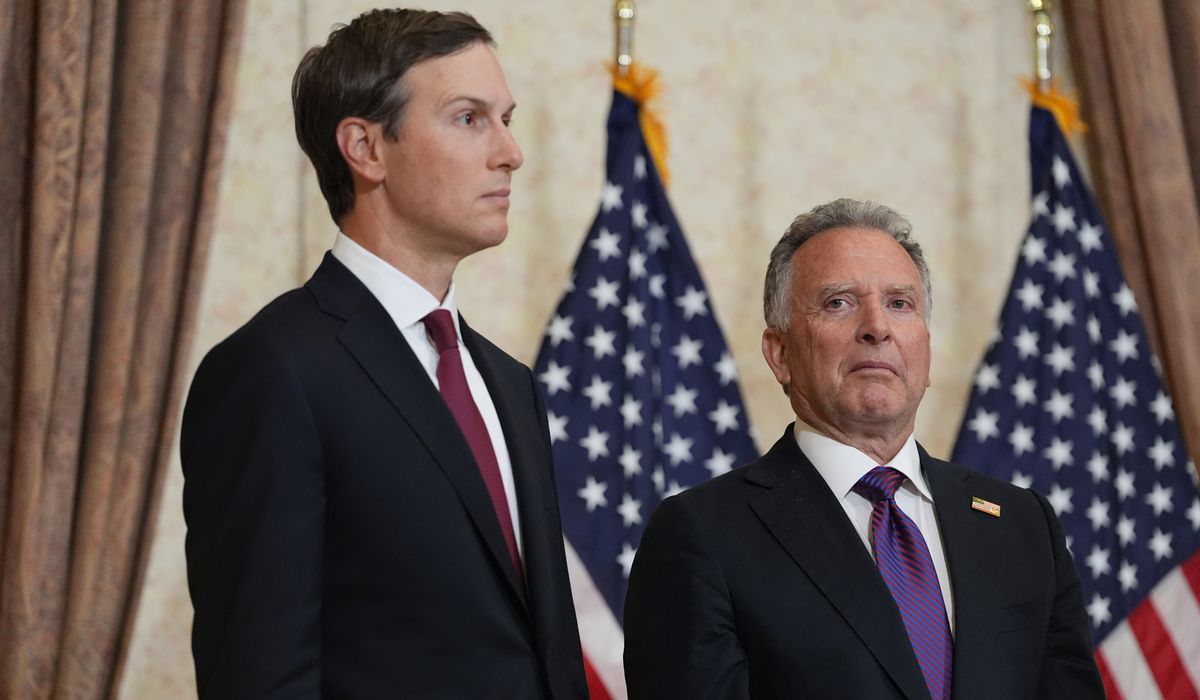
Steve Witkoff and Jared Kushner, who is Mr. Trump’s son-in-law, sat down with Qatari Prime Minister Sheikh Mohammed bin Abdulrahman bin Jassim Al Thani, according to a senior administration official.
The official said the U.S. and Iranian delegations were expected to meet separately with mediators from Qatar and Pakistan on Wednesday.
The parties are working toward a final deal that ends the war permanently and prevents Iran from getting a nuclear weapon, though both countries are talking tough and recently traded military strikes in the region.
Iranian officials said they remain concerned about fighting in Lebanon, and they berated the U.S. over its treatment of the Iranian national soccer team at the World Cup. The team was required to return to its base camp in Mexico immediately after games in the U.S.
Iranian Foreign Minister Seyed Abbas Araghchi criticized Homeland Security Markwayne Mullin on Tuesday for telling reporters he did a “happy dance” after Iran was eliminated from the tournament.
“You also accomplished something else: proving to the world that you have no business hosting an international tournament,” Mr. Araghchi said on X. “Your conduct has been a masterclass for how to squander the dignity that comes with being a host.”
Iran’s foreign minister, Esmael Baghaei, said Tuesday that Iranian diplomats would be in Qatar for two days for peace talks, but would not meet with U.S. officials.
The delegation’s role, he said, would be to discuss U.S. progress toward implementing the provisions of the memorandum of understanding with Qatari mediators.
Iran and the U.S. previously met for direct negotiations earlier this month in Geneva after the two countries signed the U.S.-backed memorandum of understanding, which established a ceasefire and a 60-day negotiating window.
Indirect discussions in Doha are unfolding after both sides exchanged military strikes over the weekend, threatening to destroy progress and the fragile ceasefire agreement. Both sides agreed to stop shooting and start talking again, even if it is unfolding through intermediaries.
Read more Sorry, Virginia, space aliens have not visited Earth
Mr. Baghaei said Iranian officials will discuss the status of $6 billion of frozen Iranian assets held in Qatar this week. Mr. al-Ansari said on Tuesday that the assets had not been transferred to Iran and that procedural negotiations had not taken place.
Iranian President Masoud Pezeshkian said Monday that $6 billion of the $12 billion in funds held in Qatar would be released and returned.
Under the terms of the memorandum of understanding, the U.S. must make Iran’s frozen assets available after the implementation of the agreement.
However, U.S. officials have remained adamant that Iran will not have access to any funds until it meets certain criteria, such as keeping the Strait of Hormuz open to shipping.
The agreement also calls for a comprehensive ceasefire on all fronts of the conflict, including in Lebanon, where Israel and the Iran-backed militant group Hezbollah have been at war since early March.
Mr. Baghaei said Tuesday that Tehran’s “position on Lebanon is clear” and it expects the U.S. to wind down the war in all places.
“The U.S. commitment to ending the war on all fronts, especially Lebanon, as per Article 1 of the memorandum of understanding, is important to us,” he told Islamic Republic of Iran Broadcasting, a state-media outlet.
Another point of debate is whether Iran plans to impose tolls or fees on ships transiting the Strait of Hormuz. There were no tolls before the war, because the strait is considered an international waterway open to free transit.
Yet Iran, with possible cooperation from Oman on the opposite shore of the strait, has complicated negotiations by signaling a desire to monetize the strait by imposing fees on passing ships.
Senior Trump officials have repeatedly warned the countries not to follow through on tolling plans, saying it would violate international rules and set a terrible precedent for other waterways.
Read more House GOP rebels shut down legislative agenda for second consecutive week
About the Author